Final Exam Optional: The Whole Course in One Place
Part 12 of 12 · Back to School
Twelve posts on Washington's Clean Buildings Performance Standard, in one place. What the law is, what it requires, when it's due, what it pays, and who will help you for free.
By Jeff Nichols
A little while back I started writing about a law most of the people it covers had never heard of.
Washington's Clean Buildings Performance Standard reaches roughly 28,000 buildings, about 18,000 of them in Tier 2, and the owners of those buildings are mostly not energy professionals. They run churches, apartment buildings, childcare centers, and mid-sized offices. The state sent them a letter, but a lot of them never saw it.
So this fall I tried to write the thing I wished existed: what the law is, what it requires, when it is due, what happens if you miss it, what it pays, and who will help you for free.
That’s finished now. The whole course is below, and it will stay up.
What any of this is actually for
We have spent this whole series on the mechanics. What the law is. What the dates are. What the penalties are. How to find someone to help. Where to get a question answered for free.
All of that matters. But writing it, I kept circling the same question.
What is any of this actually for?
Because it is not for the paperwork. Filling out forms isn't the objective. I have said that so many times this fall that I suspect some of you are tired of reading it.
And it is not really for the penalties either. A program measured by how many fines it collects would be a failed program, and everything we have seen this year suggests that is not how Washington is running it.
Where I landed is that the value is in creating an orderly, transparent process that lets building owners, policymakers, utilities, engineers and contractors understand the existing building stock, and then make smarter decisions about where limited capital and resources should go.
That is a systems answer, and systems are made of people.
Which is the part I did not expect to land on when I started writing. The law is an accounting exercise on paper. In practice it is an operations director at a church who has never heard the phrase energy use intensity, a contractor deciding whether this market is worth staffing up for, and someone at Commerce trying to reach 18,000 owners with a letter that goes to whoever pays the property tax.
None of those people are in the statute. All of them determine whether it works.
If you read nothing else, this is the short version
Someone will find this post months from now with a deadline in front of them and no appetite for twelve blog posts. So here is the whole thing compressed.
If you own a building over 20,000 square feet in Washington, you are almost certainly covered. If it falls between 20,000 and 50,000 square feet, or it is multifamily at any size above 20,000, you are Tier 2 and your date is July 1, 2027.
Tier 2 compliance is three things. Benchmark the building, implement an operations and maintenance program, and create an energy management plan. You also calculate an energy use target, but this cycle you are not required to meet it. You work out what a building like yours should use, compare it to what yours actually uses, and report the gap.
Two dates come before the deadline. Exemption applications close 180 days ahead of your compliance date, which for Tier 2 is January 2, 2027. And the extension window, which gives you two more years, runs from six months before your date to six months after it. That second one is the door that stays open after you have already missed.
The state will pay you thirty cents a square foot for doing the work, up to seventy-five cents for qualifying multifamily. The maximum penalty for not doing it is also thirty cents a square foot. Same number, opposite direction.
And if you only take one thing from this entire series: you do not have to figure this out alone, and you do not have to pay anyone to ask a question. The Clean Buildings Help Desk at the Smart Buildings Center will answer the phone.
The syllabus
Eleven posts got us here. If you are coming to this late, or you want to send one to someone, here is the whole course in order.
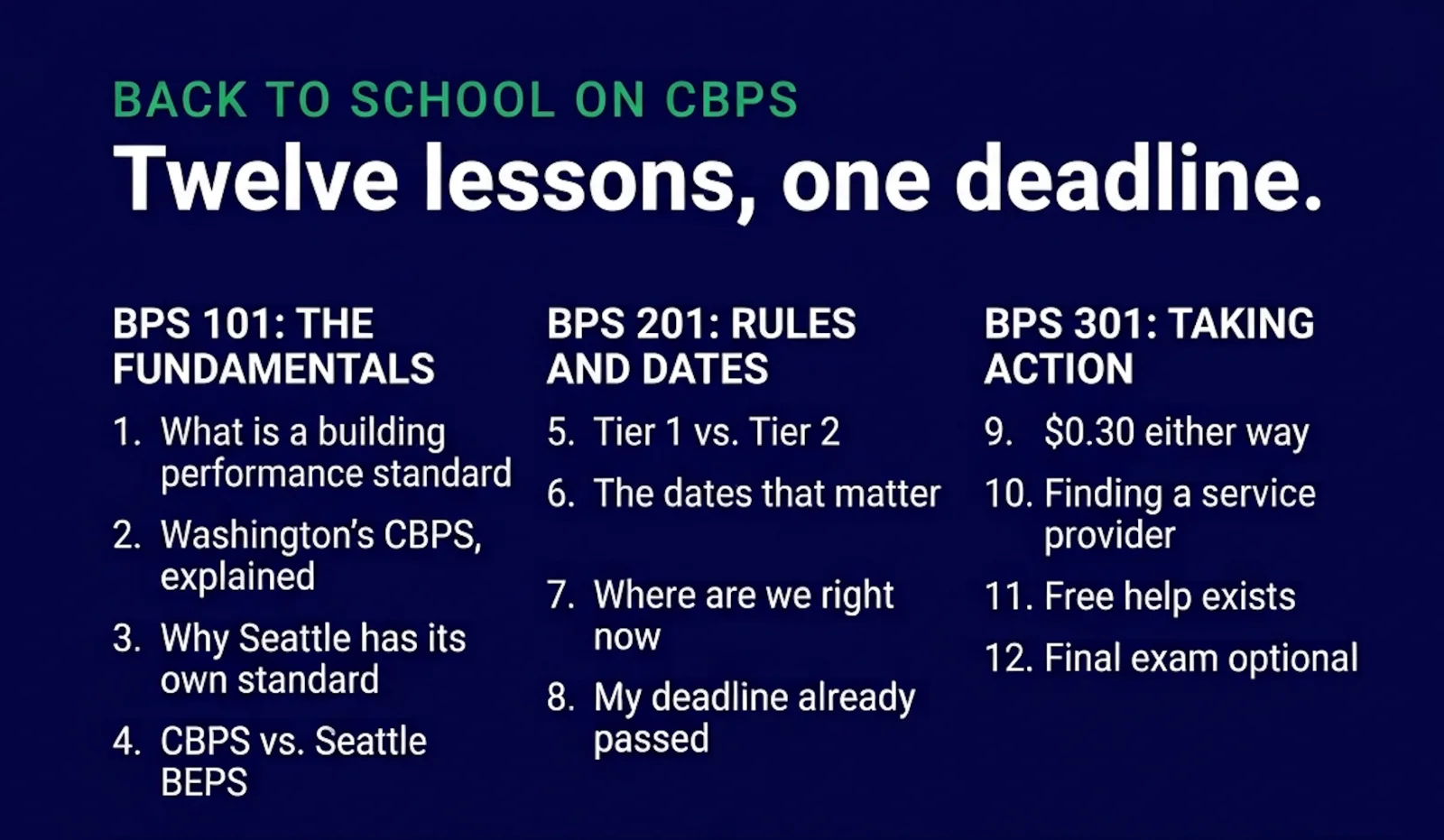
Unit 1. BPS 101: The Fundamentals
- 1. Welcome to BPS 101: What Is a Building Performance Standard?
- 2. Washington's Clean Buildings Performance Standard, Explained
- 3. Why Does Seattle Have Its Own Standard?
- 4. CBPS vs. Seattle BEPS: Efficiency vs. Decarbonization
Unit 2. BPS 201: The Rules, The Dates, The Process
- 5. Tier 1 vs. Tier 2: The Big Buildings Came First. Now Comes the Long Tail.
- 6. The Dates That Matter (Mark Your Calendar)
- 7. Where Are We Right Now in the Compliance Process?
- 8. My Deadline Already Passed. Now What?
Unit 3. BPS 301: Taking Action
- 9. $0.30 Either Way: Washington's Tier 2 Early Adopter Incentive, Explained
- 10. "I Don't Want to Figure This Out Myself": How to Find a Reputable Service Provider
- 11. Free Help Exists: Where to Get Your Questions Answered
If you only read two, make it number six for the dates and number eleven for the phone numbers.
Come find us at the booth
One practical note before the syllabus.
Pilotlight is at Smart Buildings Exchange on November 9 and 10 in Seattle, and our booth is next to the SBX Studio. Tuesday the 10th is the day worth planning around, because that is when we are recognizing the first Building Performance Standards Champions.
These are Washington's top Clean Buildings filers. Five in each category: Tier 1 by size band, Tier 2, public sector buildings, and large owner-operators. This is a Pilotlight activation rather than official conference programming, and recipients have to be present, so if you have been nominated, be in the room.
There is also a Clean Buildings trivia wall, a Build-a-Bot giveaway of ten hours of AI agent advisory, and a short video contest.
Perry England is speaking on day two, and his day one workshop on the barriers to reaching market scale is the one I would sit in on if I could only pick one session.
If you have been reading along this fall and want to talk through your actual building, come by. That is a genuine offer, not a closing line.
Graduation The final exam is optional. It always was.
Nobody is grading you on whether you read twelve blog posts. What the next eight months actually ask of you is much simpler, and I will say it one more time because it has been the spine of this whole series.
Understand the building. Get the data. Build the plan. Take advantage of the incentives while they are available.
There is no single technology that solves the building energy problem. Not solar alone. Or wind. Or heat pumps. Or batteries. All of them help. So does something far less glamorous, which is making the buildings we already have work better.
We cannot build our way to a more efficient future, we have to improve what we already have.
Building performance standards are the mechanism. The point is buildings that work better, and the people who do the work inside them.
Now let's get to work.