Free Help Exists: Where to Get Your Questions Answered
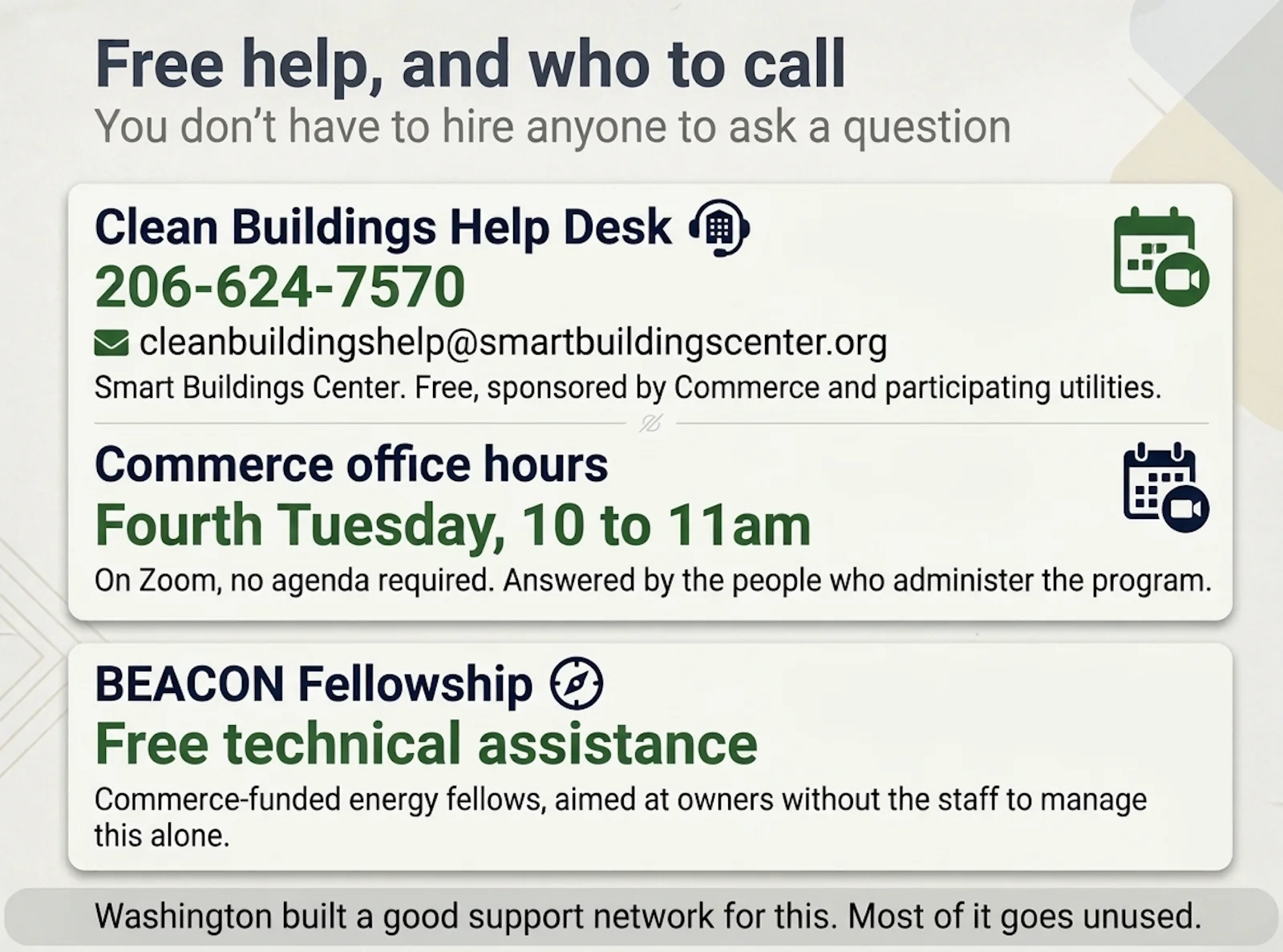
There's a phone number you can call, right now, and a person will answer your Clean Buildings question for free. Washington built a genuinely good support network for this program, and most of it goes unused because owners don't know it's there.
By Jeff Nichols
There is a phone number you can call, right now, and a person will answer your Clean Buildings question for free.
Almost nobody knows that.
Last week I wrote about hiring a provider, and that post assumed you already know you have a project. A lot of people reading this don't. They have a question. Maybe one question. Something like *is my building even covered* or *what does benchmarking actually mean* or *I got a letter and I don't understand it.*
You don’t need to hire anyone to get those answered. Washington has built a genuinely good support network for this program, funded by Commerce and the utilities, and most of it goes unused because owners don't know it's there.
Here's the whole list.
Start here: the Clean Buildings Help Desk
The Smart Buildings Center runs a Clean Buildings Help Desk, sponsored by the Department of Commerce and participating utilities. It exists specifically for the "I just have a question" moment.
You can email [email protected], call 206-624-7570, or book a virtual meeting online. The virtual option is the one I'd recommend if your question is about the portal or a tool, because you can share your screen and walk through it together rather than describing the problem in an email.
This is free. There is no catch and nothing to sign. If you only take one thing from this post, take this one.
Commerce's monthly office hours
Commerce holds open office hours on the fourth Tuesday of every month, 10 to 11am Pacific, on Zoom. Registration is on the Tier 2 compliance page.
No agenda required. You can bring a question about your specific building, and the people answering are the people who administer the program. That is about as direct as it gets, and it costs nothing but an hour.
Put it in your calendar as a recurring event. Even if you don't attend most months, having it there means the answer is never more than four weeks away.
The BEACON Fellowship
This one is the least known and possibly the most relevant to the readers of this series.
Commerce funds the Building Efficiency and Clean Operations Network, which trains energy fellows to provide free technical assistance to building owners. It is aimed explicitly at owners who lack the staff and resource capacity to manage compliance on their own, and the program is built to assist thousands of buildings.
If you are a church, a nonprofit, a community organization, or a small business with a covered building and no facilities department, this program was designed with you in mind. Commerce maintains a BEACON page with current information on requesting a fellow.
Free tools and training, all of it
- The standard itself. Commerce provides the full integrated Clean Buildings Performance Standard at no cost through a request form. You do not have to buy the ASHRAE document. Make sure you're getting the 2026 version, since the rules were updated this year.
- A free Qualified Energy Manager course. Commerce and the Smart Buildings Center offer a QEM on-demand course at no charge, designed for building operators, energy managers, and facility staff working toward Tier 2 compliance. If you have someone on staff who is technically capable and curious, this is a real option.
- Energy management plan and O&M templates. Commerce publishes a Word template for the energy management plan and an Excel-based O&M Program Development Tool, both free, both with video tutorials. Neither is required, and an existing program that meets the standard is fine. But starting from a blank page is nobody's idea of a good time.
- Clean Buildings 101 and the training library. Commerce maintains recorded trainings and webinars, including a Clean Buildings 101 session that is the right starting point if you're new to all of this.
- ENERGY STAR Portfolio Manager training. EPA runs a free training series on the benchmarking tool itself. If the tool is your obstacle, this is the direct fix.
- A tool lending library. The Smart Buildings Center lends diagnostic equipment, free, to building owners and energy professionals across Washington and Oregon. Data loggers, power meters, lighting loggers, infrared cameras, flow measurement devices, more than eighty tool types. Most loans run a week, data loggers two to four. You sign a customer agreement and book a pickup. Most owners have no idea this exists.
Your utility
Your utility is a resource and most owners never think to call them.
Two reasons. First, utilities with more than 25,000 customers are legally required to provide your energy consumption data on request, and to deliver it through Portfolio Manager's automated upload. That solves the single most time-consuming part of benchmarking, and it starts with an email to your account rep.
Second, your utility is who actually pays the Early Adopter Incentive so they have a direct interest in helping you get there. Several utilities also run their own accelerator or navigator programs offering free compliance support, which Commerce lists as no-cost assistance alongside the help desk.
If your building is in Seattle
Seattle's Office of Sustainability and Environment can be reached at [email protected], and it publishes BEPS FAQs and a benchmarking map where you can look up your building and get an early read on your emissions target.
The Seattle Building Emissions Navigator offers free coaching covering both the city and state laws together, which is the right framing if you're subject to both.
One honest caveat about the directories
Commerce maintains directories of qualified persons, qualified energy auditors, and qualified energy managers, and they're a reasonable starting point for finding a professional.
But participation in those directories is voluntary. Commerce has actively called on credentialed professionals to add themselves, which means the lists are not exhaustive. If you can't find someone near you, that is not evidence that nobody near you does this work. Ask the help desk, ask your utility, ask your mechanical contractor.
When free help is enough, and when it isn't
The honest line is question versus project.
Free help is enough when you need to know whether you're covered, what a term means, how to get into the portal, where to find a form, what the deadline is, whether an exemption might apply, or how to request your utility data. Those are questions that have answers, and someone will give you one at no charge.
You need a provider when someone has to produce a deliverable with their professional credential attached and Tier 2 compliance requires a qualified energy manager. Somebody has to build the energy management plan, stand up the O&M program, and put their name on the compliance submission. Free help will tell you what needs to exist, but it will not build it for you.
Both are legitimate. The mistake is assuming you need the second when you only needed the first, and putting the whole thing off for another year because the second sounded expensive.
Why I wanted to write this one
Somewhere in the rollout of this program, the message to smaller building owners became *become an expert*.
I don't think that's right, and I don't think it's what anyone intended. As an industry, we should be making this easier rather than adding burden. The first part of that is simply telling people what they actually need to do, and where to get help doing it.
That's most of what this series has been.
So here's my ask. Bookmark this post. Then send it to one building owner you know who probably has no idea any of this applies to them, because based on what we've seen this year, there's a good chance you know several.
Next week we finish the semester, and I'll tell you where to find all of these people in one room.
If I can be helpful to any of you, reach out.
Sources
- Smart Buildings Center, Clean Buildings Helpdesk (contact methods, booking, sponsorship)
- Washington Dept. of Commerce, CBPS Support (office hours schedule and registration, QEM training, voluntary directories)
- Washington Dept. of Commerce, BEACON Fellowship Project
- Washington Dept. of Commerce, CBPS Tier 2 compliance (free EMP template, O&M tool, standard request form, portal access)
- Washington Dept. of Commerce, Clean Buildings Performance Standard (no-cost assistance, utility accelerator and navigator programs)
- RCW 19.27A.170 (utility obligation to provide energy consumption data)
- Seattle Office of Sustainability and Environment, Building Emissions Performance Standard
- Seattle Building Emissions Navigator
- EPA ENERGY STAR, Portfolio Manager training