Efficiency Is Not the Same as Emissions
Part 2 of 2 · The Thermal Series
Cut 10% of your energy, cut 10% of your emissions. In a hydro-powered state that is wrong by a wide margin, and the reason has everything to do with which hours you cut.
By Jeff Nichols
Here’s a question I’ve started asking building owners, and almost nobody gets it right on the first try.
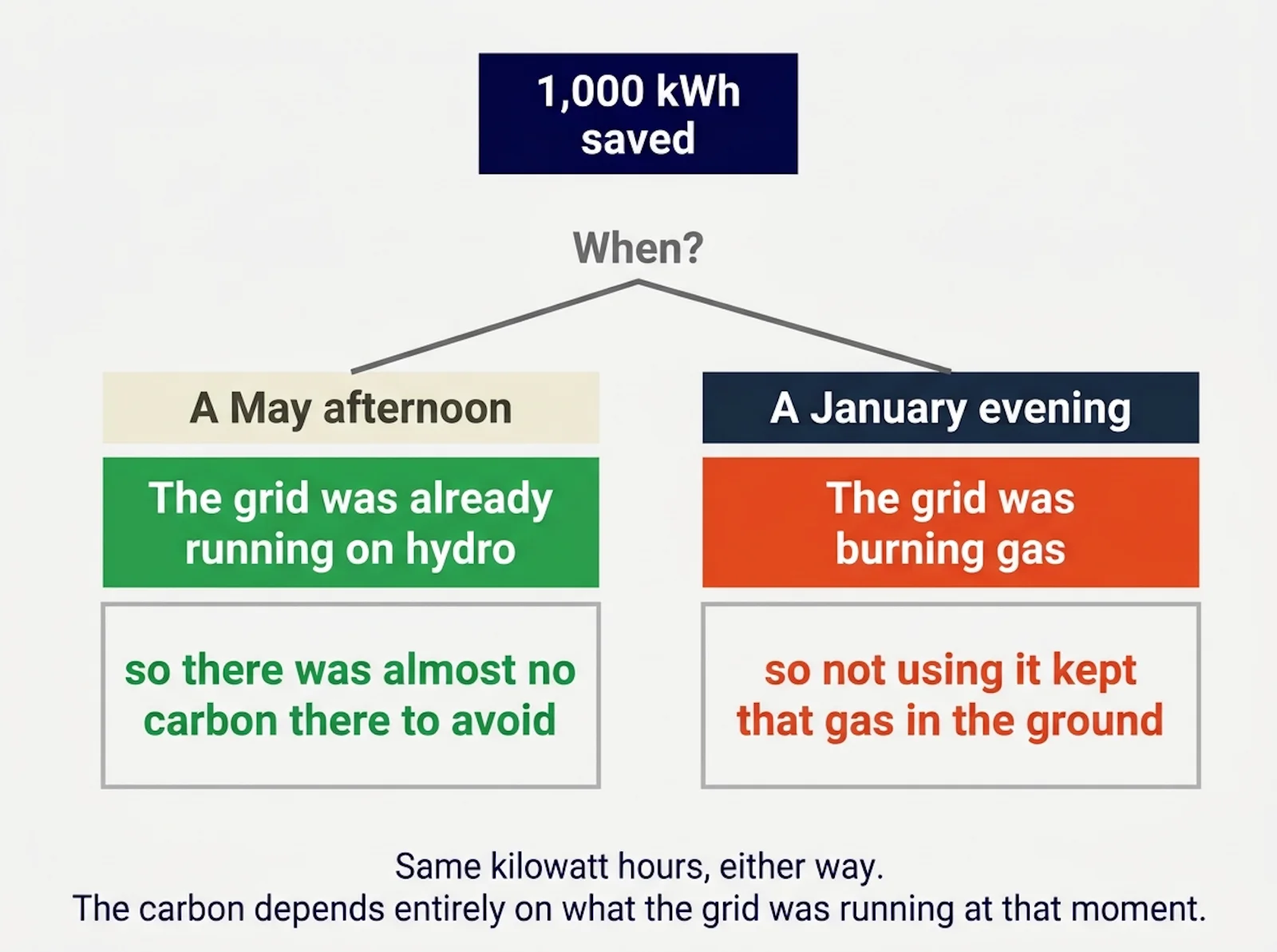
Your building uses a thousand kilowatt hours less this month than it did last month. How much carbon did you just avoid?
The intuitive answer is that it scales. Cut 10% of your energy, cut 10% of your emissions. That’s how most people think about it and it’s how most marketing describes it. However, in a state powered largely by hydroelectricity it’s wrong by a wide margin.
The honest answer is that it depends entirely on when you cut it.
The average isn’t the number you want
Washington generates about 64% of its in-state electricity from hydropower. Seattle City Light is at roughly 88% hydro and has been carbon neutral since 2005, the first large utility in the country to achieve it.
Those are annual averages, and annual averages are the wrong tool for this question. What you actually want to know is the marginal emissions rate: when your building draws one more kilowatt hour at a specific moment, what generates it? Not what’s in the portfolio on average across the year, but what the system turns on to meet that incremental demand right then.
In the Northwest, at 2pm on a mild Tuesday in May, the answer is close to nothing. The rivers are running, demand is low, and there’s surplus. Your marginal kilowatt hour comes from water that was going downstream anyway.
At 6pm on a cold Tuesday in January, the answer is completely different.
What the utility says about its own peak
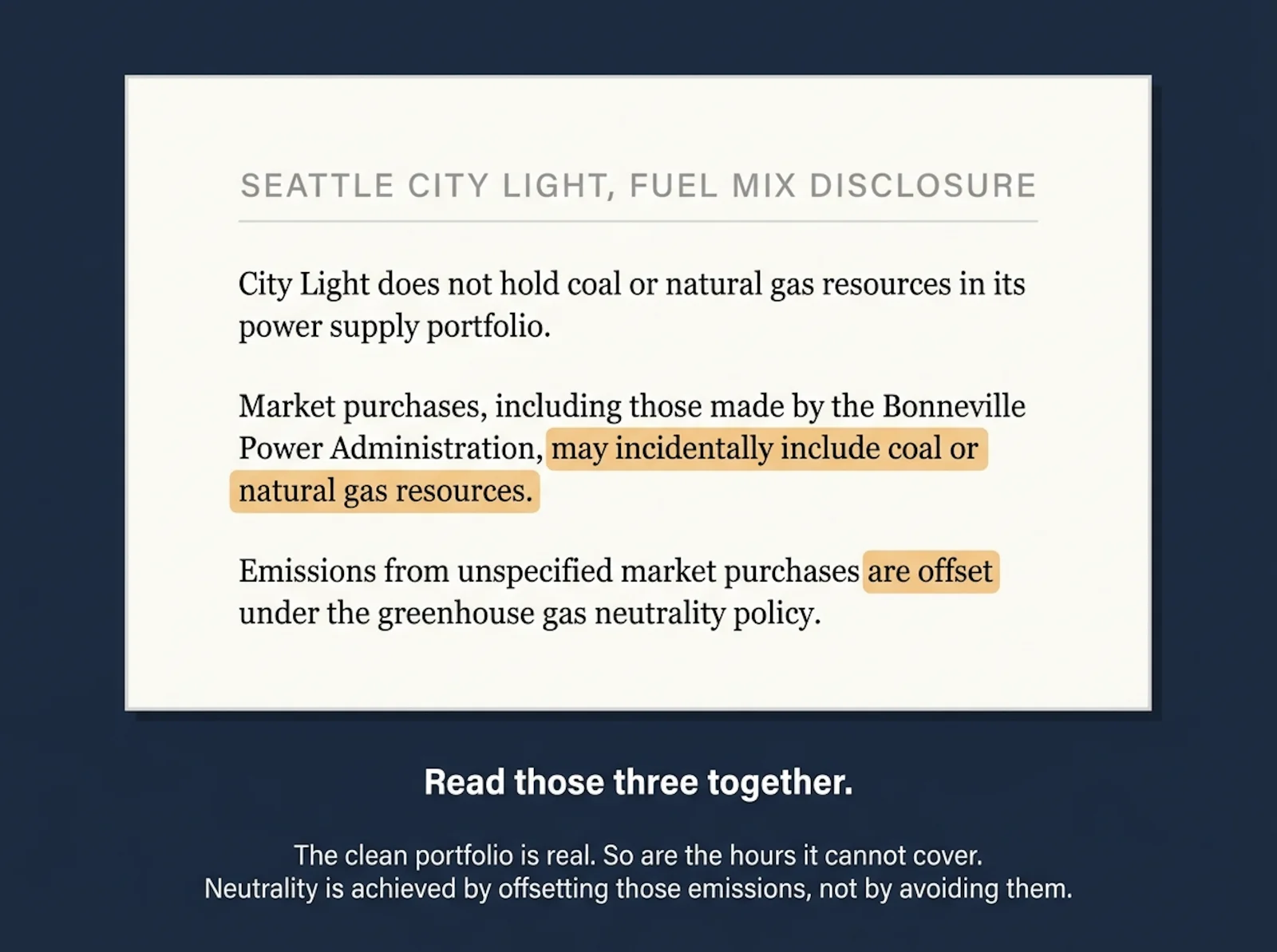
Seattle City Light publishes a fuel mix disclosure, and it includes a passage worth reading slowly.
They state that City Light doesn’t hold coal or natural gas resources in its power supply portfolio. Then they state that market purchases, along with market purchases made by the Bonneville Power Administration, may incidentally include coal or natural gas resources, which are assigned to the utility. Then they state that any emissions associated with unspecified market purchases are offset through their greenhouse gas neutrality policy.
Read that as a sequence and it describes something specific. The utility owns clean generation. During hours when owned generation can’t cover load, it buys on the market. What it buys may be fossil, the emissions from those purchases are real, and they’re neutralized by purchasing offsets rather than by not emitting.
This isn’t a criticism of City Light. Carbon neutrality through offsets is a legitimate and common approach, and they got there two decades before almost anyone else. The point is narrower: the clean number is an annual average that includes offsets, and underneath it there are hours when the marginal kilowatt hour is gas.
Which hours
The Northwest has always been a winter-peaking system. The Council's own planning documents put regional loads highest during cold snaps on December and January mornings and evenings.
A survey of regional utility integrated resource plans found that most utilities expect to meet a significant portion of their peak capacity requirements through front office transactions, which is the industry term for buying on the market rather than generating it yourself.
Put those two facts together. The hours when the region is shortest are winter mornings and evenings. The way utilities plan to cover those hours is by buying. What they buy is whatever the regional market is dispatching, which during a regional cold snap is gas.
So the dirtiest kilowatt hour your building consumes all year is probably one it consumed at 6pm on a January evening, when it was cold everywhere at once and the entire region was bidding for the same thermal generation.
What this means for a retrofit decision
This is where it stops being a grid trivia question and starts affecting capital. Consider two efficiency projects in the same building, each saving the same annual kilowatt hours for roughly the same cost.
The first is a lighting retrofit. Lighting load is relatively flat and much of it runs during daylight and business hours. The savings are real, they show up on the bill, and in carbon terms a meaningful share of them land during hours when the marginal generator was a dam.
The second is a heating system upgrade, or a controls project that shifts morning warm-up earlier and reduces evening demand. Those savings concentrate in winter mornings and evenings, which are precisely the hours when the marginal generator is thermal.
Same annual kilowatt hours. Substantially different carbon outcomes.
Nobody is going to tell you this because the tools we use to evaluate these projects almost universally multiply annual savings by an annual average emissions factor. That method is simple, it’s standard, and it systematically understates the value of anything that reduces peak demand.
It also systematically overstates the value of anything that reduces summer daytime demand, which in this region is when the system has the most slack. A region with a July peak would have the opposite problem. The point isn’t that one kind of project is good and another bad, it’s that the measurement tool is blind to the distinction entirely.
There’s a second-order effect worth knowing about too. The Council's planning documents make a point that sounds technical and isn’t: the Northwest power system can’t sustain its single-hour generating capability over long periods, so the more appropriate measure is what the system can hold for three days, which approximates the duration of a cold snap. Your building's contribution to that problem isn’t its worst hour, but worst week.
And the two laws disagree
If your building is in Seattle, this isn’t an abstraction, because you’re subject to two standards that measure different things.
Washington's Clean Buildings Performance Standard targets energy use intensity. It cares about kilowatt hours and British thermal units per square foot, it doesn’t care when you used them.
Seattle's Building Emissions Performance Standard targets greenhouse gas intensity, applying emissions factors by fuel type and cares about the carbon, not the energy.
For a downtown building those two laws can point in different directions, and a project that improves one can do very little for the other. That deserves its own post, and it will get one later in this series.
What I’d actually do about it
Three things, none of which require new equipment.
Know your load shape, not just your annual total. If your building is benchmarked, which it probably is if it’s over 20,000 square feet in Washington, you have monthly data. Monthly is coarse but it will show you whether your consumption is winter-heavy, which most heated buildings in this region are.
When you evaluate projects, ask when the savings land. Not just how many kilowatt hours, but which hours. A project that cuts winter evening demand is doing more carbon work per dollar than its annual numbers suggest.
Treat peak reduction as its own objective. Not as a side effect of efficiency, but as a distinct thing worth pursuing, because the grid value and the carbon value are both concentrated there.
None of this makes general efficiency a bad idea. Using less energy is good, it lowers your bill in every hour, and it’s the cheapest resource the region has. The region's own draft power plan counts more than a thousand average megawatts of efficiency as a core resource.
The argument is narrower than that. In a hydro-powered region, cutting kilowatt hours and cutting carbon are related but genuinely different jobs, and if you only measure the first one you’ll systematically undervalue the work that does the second.
Where we fit
Pilotlight is a compliance platform for building performance standards, which means the data we help owners collect is the energy use side of this: what the building consumed, measured and reported the way the law requires.
The reason the carbon side matters to us is that owners in Seattle are subject to both standards, and the data that satisfies one is the starting point for understanding the other. A building that’s benchmarking because the law requires it already has the raw material for a much more interesting question than the one the law asks.
If you aren’t sure which standards apply to your building, our compliance navigator at pilotlight.ai/search will tell you in about a minute, and it’s free.
Sources
- Seattle City Light, Environment and power mix disclosure
- Northwest Power and Conservation Council, Sixth Northwest Conservation and Electric Power Plan, Chapter 3
- Northwest Power and Conservation Council, Draft Ninth Power Plan (August 2026)
- E3, Resource Adequacy in the Pacific Northwest
- U.S. Energy Information Administration, Washington State Energy Profile