Downtown Seattle Runs on Steam, and Most People Have No Idea
Part 1 of 1 · The Thermal Series
There's a hundred-year-old steam network under downtown Seattle serving about 150 buildings, including three hospitals, and it's about to electrify. What that does to its emissions is more complicated than it sounds, and the complication is the whole point.
By Jeff Nichols
There’s a hundred-year-old steam network under downtown Seattle and it heats the hospitals, but almost nobody who works downtown knows this. You can stand on Western Avenue, look at a brick building with a smokestack, and have no idea you’re looking at the thing keeping Harborview's surgical instruments sterile.
I want to spend this post on that system, because it’s interesting on its own terms. But I also want to use it to set up something larger, which is that we’ve built an entire climate conversation around electricity and left out most of the energy.
What’s actually under there

The company was organized in 1889, a few months before Washington became a state, and started producing steam in 1903. It has operated continuously ever since under a series of names: Seattle Steam, then Enwave Seattle, and since 2021, CenTrio.
The physical system is about 18 miles of insulated steel pipe running under downtown and up to First Hill. Steam is generated at a plant on Western Avenue, pushed out through those pipes, and delivered to buildings that use it for space heating, hot water, humidity control, and in the case of hospitals, sterilization.
Today it serves somewhere between 140 and 150 buildings. Among them are Virginia Mason, Swedish and Harborview, the Seattle Central Library, and the Seattle Art Museum.
When Stan Gent ran the company, he put its share of Seattle's total energy use at about 7%. That’s one private utility, invisible to almost everyone, carrying a measurable slice of the city's energy.
Why a city would do this at all
District energy sounds like a quaint hangover from the age of coal, and in Seattle's case it literally is. Coal and oil fired the boilers until 1952, when natural gas was added and coal was dropped.
But the logic holds up better than the vintage suggests. A hospital that makes its own steam needs a boiler, a boiler room, fuel delivery, emissions permits, maintenance staff, and a redundant backup for the hours when the first one fails. Multiply that by every large building in a dense downtown and you have hundreds of small combustion plants, each sized for its own worst day, each sitting idle most of the year.
One central plant serving all of them is smaller than the sum of those boilers, because not every building peaks at the same hour. It’s also easier to upgrade. Changing the fuel source at one plant changes the carbon footprint of 150 buildings at once, with no construction in any of them.
That last point is the one worth holding on to, because it’s about to matter.
The upgrade nobody noticed
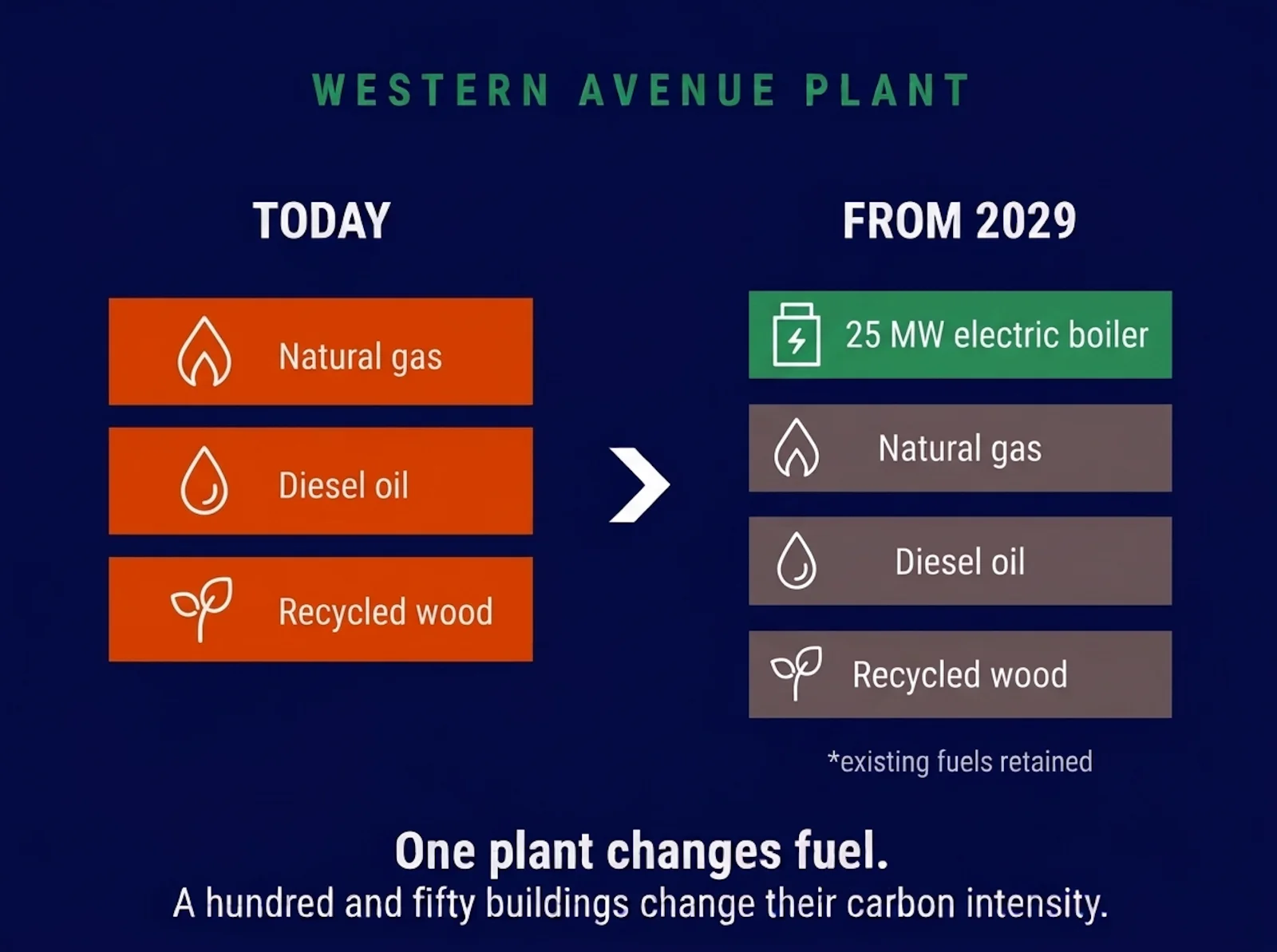
In October 2026, CenTrio announced that it’s installing a 25 megawatt electric boiler at the Western Avenue plant.
The engineering design is underway with Affiliated Engineers, and the company is working with Seattle City Light to secure the power. Construction is planned to start in 2027, with the boiler expected to run about two years after that. It will produce roughly 85,000 pounds of steam an hour. At maximum use, CenTrio estimates it cuts emissions by more than 60%, around 42,000 tons a year. About $4 million in state grant funding is behind it.
The company's general manager for Seattle made the district argument explicitly: customers get low-carbon steam without undertaking major individual retrofit projects, which means no capital cost and no disruption inside the building.
For an owner of an older downtown building facing building performance standards, that’s a genuinely unusual proposition. The carbon intensity of your heat improves because someone else changed their equipment.
And here’s where it gets complicated
I’ve been writing this fall about the Northwest grid, and specifically about the fact that our electricity is cheap and clean on an annual average and neither of those things during the hours when demand peaks.
Washington generates about 64% of its in-state electricity from hydropower. Seattle City Light is at 88% hydro and has been carbon neutral since 2005, the first large utility in the country to get there.
But City Light's own fuel disclosure includes a sentence worth reading carefully. They state that they hold no coal or natural gas resources, and then that market purchases, including those made through the Bonneville Power Administration, may incidentally include coal or natural gas resources, and that any emissions from those unspecified market purchases are offset under their greenhouse gas neutrality policy.
Translated: during the hours when the utility has to buy power rather than generate it, that power may well be fossil. Neutrality is achieved by offsetting those emissions, not by avoiding them.
The Northwest is a winter-peaking system. The hours when City Light is buying hardest are cold winter mornings and evenings, which is precisely when heating demand is at its highest.
So moving a 25 megawatt thermal load from gas onto the electric grid doesn’t eliminate those emissions. It relocates them, from a boiler on Western Avenue to whatever the regional market is dispatching at 6pm in January.
I want to be careful here. This isn’t an argument against electrifying the steam plant. Electrification is almost certainly the right direction, the grid gets cleaner over time, and a 42,000 ton reduction is a real number. It’s an argument that the accounting is more complicated than the press release suggests, and that the complication lives in the peak.
The thing we keep leaving out
Here’s the broader point, and it’s the one this series is going to spend several posts on. When we talk about clean energy in this country, we almost always mean electricity. Generation mix, renewable portfolio standards, interconnection queues, battery storage. All electricity.
But a very large share of the energy a city actually consumes isn’t electricity. It’s heat. Space heating, water heating, industrial process heat, sterilization, drying, cooking. In the United States we mostly treat that as a collection of individual building problems, solved building by building with individual equipment.
Europe doesn’t frame it that way. District heating supplies around 12 to 13% of EU heat demand overall, but in Denmark it’s somewhere between 50 and 66% depending on the measure, in Sweden around 55%, and above half in Finland, Estonia, Latvia, Lithuania and Poland. Denmark’s answer came out of the oil shocks. The country was almost entirely dependent on imported oil, got badly squeezed twice in the 1970s, and passed its first heat planning legislation in 1979 as a direct response. The structure it created has held since: municipalities are responsible for heat planning and zoning and have the final say on heat projects, and more than 90% of Danish networks are municipally or cooperatively owned rather than run for profit.
That’s not a technology difference, the equipment is the same. It’s a governance difference. Denmark decided that heat is something a city plans, the way it plans water and sewer and transit.
Seattle has the asset. Eighteen miles of pipe, 150 buildings, a century of operating history, and a plant that’s about to electrify. What it doesn’t have is any planning framework that treats that asset as civic infrastructure rather than as one private company's business decision.
Why this matters for your building
If you own a building downtown and you’re on the steam system, your carbon intensity is about to improve without you doing anything, and you should know that before you plan a retrofit.
If you aren’t on the system but you’re near it, that’s worth knowing too, because connecting to an existing thermal network is a different and often cheaper proposition than replacing your own equipment.
And if you’re nowhere near downtown Seattle, the thing to take from this is the framing. Your building's emissions aren’t a single number. They’re a function of what you use, when you use it, and what the system was burning at that moment. Those are three different questions and most compliance conversations only ask the first one.
Where we fit
Pilotlight is a compliance platform for building performance standards, which means most of what we do sits on the first of those three questions: what your building uses, measured and reported the way the law requires.
The reason the other two matter to us anyway is that Washington's Clean Buildings Performance Standard targets energy use intensity while Seattle's Building Emissions Performance Standard targets greenhouse gas intensity. A building downtown can be subject to both. Those two laws can point in different directions, and the difference between them is exactly the gap this post is about.
If you aren’t sure which standards apply to your building, our compliance navigator at pilotlight.ai/search will tell you in about a minute, and it’s free.
Sources
- CenTrio, CenTrio Seattle Advances Decarbonization with 25 MW Electric Boiler (October 13, 2026)
- Seattle City Light, Environment and power mix disclosure
- HistoryLink, Seattle Steam Heat and Power Company (Enwave Seattle)
- Euroheat and Power, District Heating and Cooling Market Outlook
- Regulatory Assistance Project, Making Europe’s Homes Hygge: Danish Lessons on District Heating (January 2025)
- Northwest Power and Conservation Council, Hydropower