Why Does Seattle Have Its Own Standard?
If you own a building over 20,000 square feet in Seattle, you are covered by two laws, not one. Why the city wrote a second one, what BEPS adds on top of state compliance, and the exemption worth knowing about.
By Jeff Nichols
If you own a building over 20,000 square feet in Seattle, you are covered by two laws, not one.
I want to start there because the most common reaction we get from Seattle owners is not confusion about either law individually. It’s the reasonable suspicion that the second law is just the first law again with a different name on it. It isn’t. The two laws ask genuinely different questions, and once you see the difference it stops feeling like duplication.
The short answer
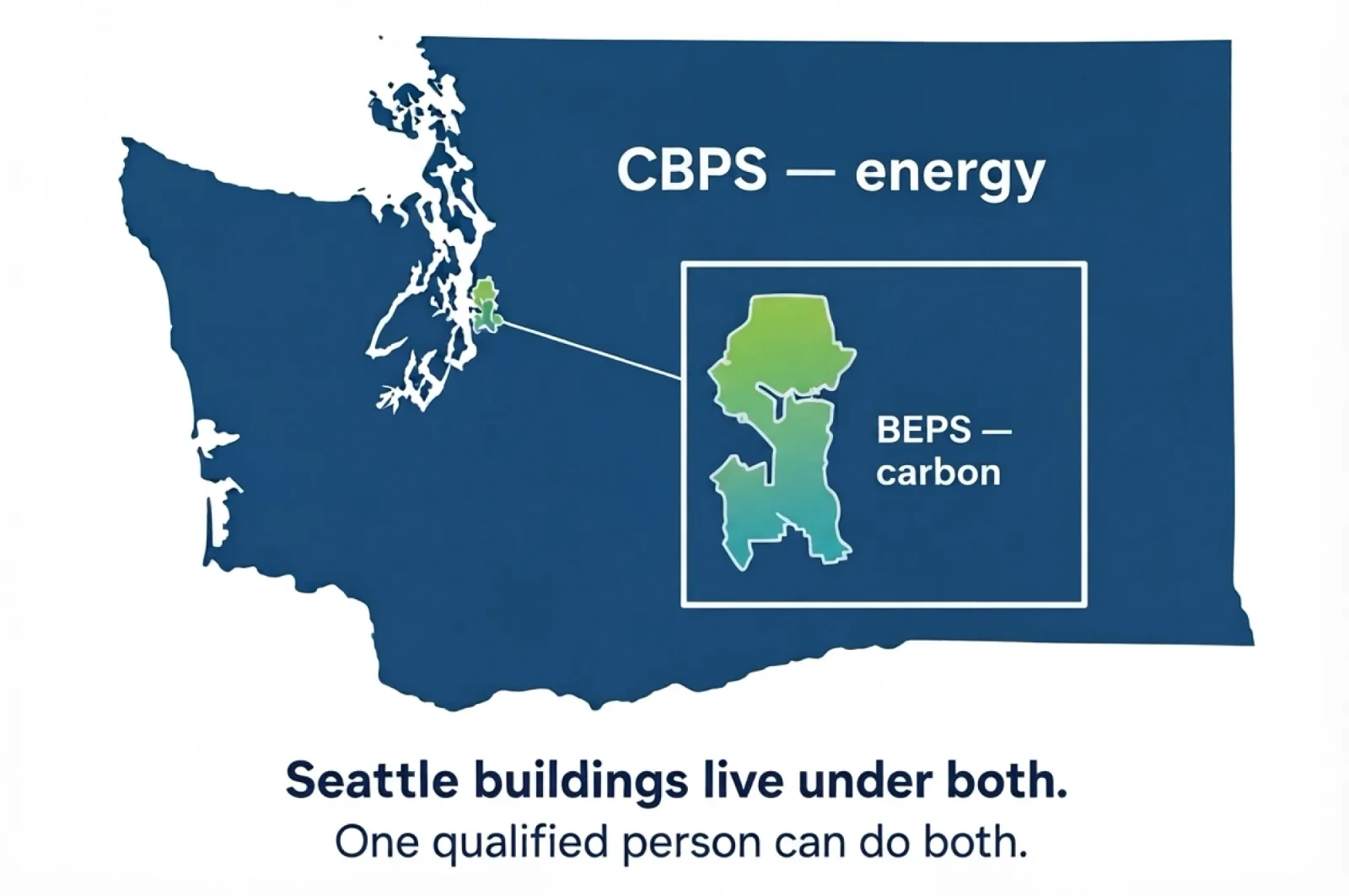
Washington’s Clean Buildings Performance Standard is about energy: how much does your building use, and how much should a building like yours use? Seattle’s Building Emissions Performance Standard is about carbon, which is not how much energy your building uses but how much greenhouse gas that energy puts into the air.
Those are related questions, but they are not the same question, and a building can perform well on one and poorly on the other. An efficient building running on natural gas can use very little energy and still emit a great deal of carbon. An older, less efficient all-electric building can be the reverse. That is the entire reason Seattle wrote a second law.
Why the city bothered
Buildings account for roughly 40 percent of Seattle’s greenhouse gas emissions. For a city trying to reduce its carbon footprint, that makes the existing building stock the single largest lever available, and no state efficiency law was going to pull it on the city’s timeline.
So in December 2023, Mayor Harrell signed BEPS into law. It covers nonresidential and multifamily buildings over 20,000 square feet, excluding parking, which is essentially the same set of buildings already reporting energy benchmarking data to the city. Industrial and manufacturing buildings are exempt, as are single family homes. All told, 4,135 buildings.
What BEPS actually adds
If you are already working on state compliance, BEPS asks for three additional things.
Benchmarking verification. A qualified person reviews your annual benchmarking data for accuracy and corrects errors. Worth knowing now: that person cannot be the same person who prepared the benchmarking report. The city wants a second set of eyes, which means if you have one vendor doing everything, you will need a second for this piece.
A greenhouse gas report. Your qualified person calculates the building’s current greenhouse gas intensity, calculates the target it will eventually need to hit, inventories your major mechanical equipment and its fuel sources, and documents a plan for getting from one number to the other.
Eventually, hitting an emissions target. A greenhouse gas intensity target, or GHGIT, measured in kilograms of CO2 equivalent per square foot per year. Targets are set by building activity type, because a hospital and a warehouse have no business being held to the same number, and mixed-use buildings get a blended target.
The first two are due somewhere in 2027 through 2030 depending on building size, and the target itself is not due until 2031 through 2035.
One thing worth being precise about
You will often see it written that Seattle’s targets tighten every five years until buildings reach net zero in the 2040s. That is true, and it is how the law is structured. Seattle publishes a full table of targets running in five-year intervals from 2031 out to 2050, and for most building types the number reaches zero somewhere between 2041 and 2045.
But there is a distinction inside that schedule worth understanding, because it changes how much weight to put on the later numbers. Only the first interval, 2031 through 2035, is fixed. The targets for 2036 onward are published, but the OSE Director has explicit authority to revise them by rule based on how buildings actually perform, how technology develops, and what other laws like the Climate Commitment Act do to emissions factors in the meantime, with that rulemaking expected to begin around 2030.
So both things are true. The trajectory to net zero is real and it is written into the law, and your 2031 target is fixed enough to plan against today. Your 2041 target is published and directionally reliable, but it can move before it binds you. Plan against the first one, and keep an eye on the rest.
And one piece of very good news
Buildings that run entirely on electricity are exempt from meeting the greenhouse gas intensity targets. If your building has already electrified, the emissions half of this is largely handled, because you still have benchmarking verification and reporting obligations but the target owners worry most about does not apply to you.
There are other off-ramps as well. Affordable housing and human services buildings can access extensions on the 2031 through 2035 targets, extensions exist for high vacancy, pre-existing financial distress and scheduled demolition, and Seattle built alternative compliance paths for owners who cannot meet a target directly.
The part that saves you money
Here is the thing most Seattle owners do not realize. The credentials Seattle requires for a BEPS qualified person are the same expertise and certifications the state requires under the Clean Buildings Performance Standard, and Seattle’s own policy guide says so plainly: owners may use the same person or vendor for both laws. One team can do both, which means you are not hiring twice.
There is also a deliberate handoff happening right now. Seattle’s Building Tune-Ups ordinance, which required periodic tune-ups for large commercial buildings, sunsets as BEPS and the state’s operations and maintenance requirements take effect, and the city did that on purpose to avoid regulating the same thing twice. If your building is in the final Tune-Ups cohort, that deadline is this week. So yes, two laws. But not two of everything.
What to do next
Two laws means two questions to answer about your building, and you can answer both in about half an hour.
For the state side, our compliance navigator at pilotlight.ai/search will tell you whether your building is covered and which tier it falls into. It is free and it asks nothing of you.
For the Seattle side, look your building up on the Seattle Benchmarking Map at seattle.gov/energybenchmarkingmap. It shows your current emissions along with an estimated future greenhouse gas intensity target, which is the number everything else in this post is building toward.
Knowing both changes the conversation from anxiety to arithmetic. You cannot fix what you cannot measure, and that is as true of carbon as it is of kilowatt hours.
Next we put the two laws side by side: what each one asks, when, and what it means if your building answers to both.
As always, if I can be helpful, reach out.
Sources
- Seattle Office of Sustainability and Environment, “Building Emissions Performance Standard.”
- Seattle OSE, “Guide to the Seattle Building Emissions Performance Standard,” January 2026.
- Seattle OSE, “BEPS GHGI Targets & GHG Emissions Factors,” January 2026.
- Seattle OSE, “Director’s Report: Seattle Building Emissions Performance Standard Proposed Policy.”