Where Are We Right Now in the Compliance Process?
The first real Clean Buildings deadline came and went in June, and compliance landed at a little over half. The reason isn't what most people assume, and the data says the buildings are in better shape than their owners think.
By Jeff Nichols
I expected better numbers in June.
The first real Clean Buildings deadline arrived on June 1 for Tier 1 buildings over 220,000 square feet. That is 1,156 buildings, held by 798 owners. These are the largest buildings in the state and they have the most at stake, in many cases six-figure fines. They are the buildings most likely to have a facilities team whose job includes exactly this.
I thought two-thirds or better of that group would at least be doing something. What we saw was a little over half.
That is not a market impression or an extrapolation from our own book of business. We filed a formal public records request with the Department of Commerce and that is what the state's own data shows.
It was not close to what I expected, and I have spent a few months thinking about why.
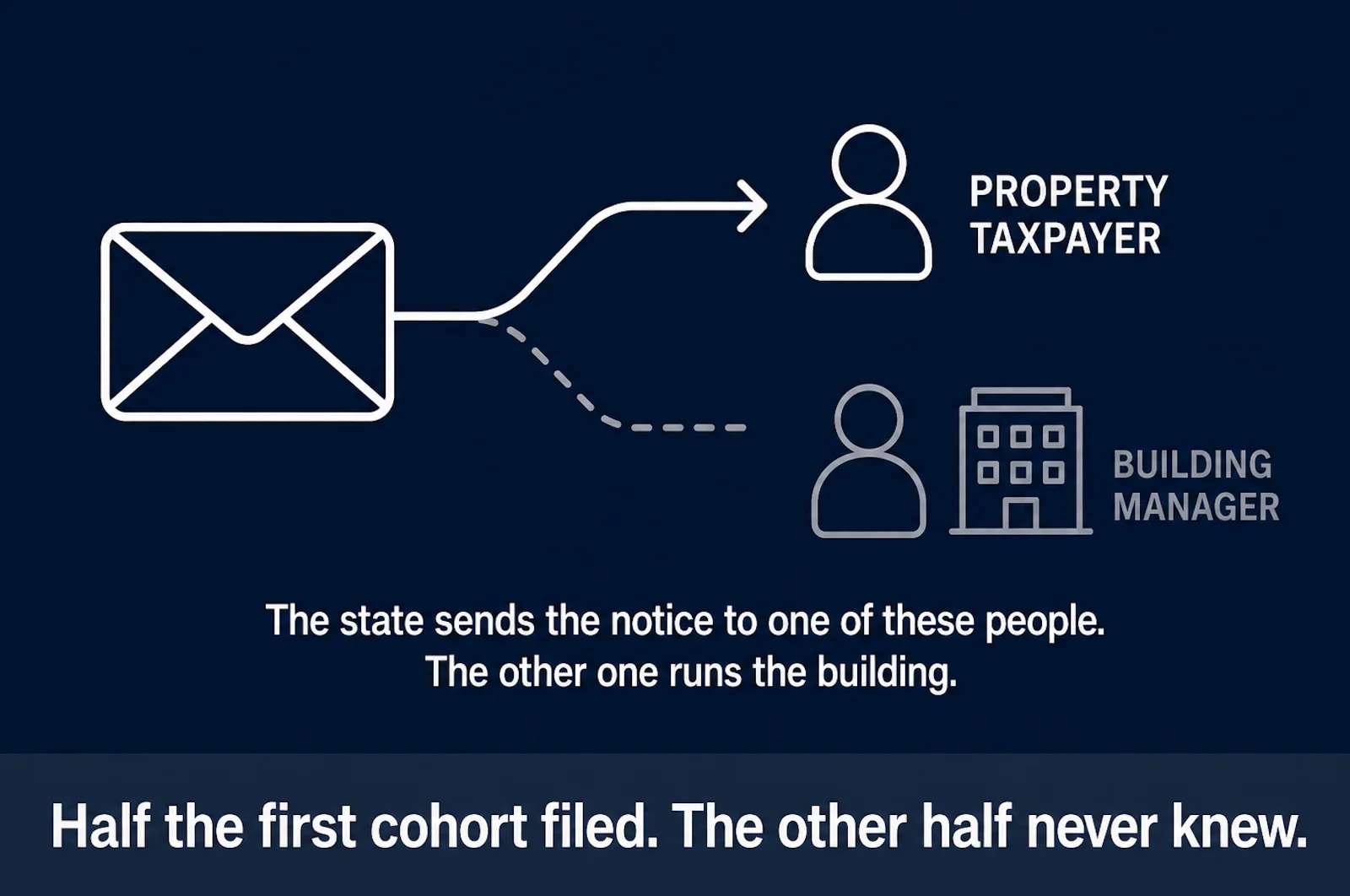
The most likely explanation is not what people assume When a compliance rate comes in low, the easy read is that owners are ignoring the law. Calculating the fine, deciding it is cheaper to pay, and moving on. I don’t think that’s what happened.
I think a large share of those owners never had the conversation at all, because the notice never reached the person who would have acted on it.
Commerce sends its Clean Buildings notifications to the property taxpayer of record. For a great many buildings, the entity paying property tax is not the entity that would handle compliance. It might be a holding company, a family trust, an out-of-state owner, or a lender. The letter arrives, lands somewhere administrative, and never gets forwarded to the person who manages the building.
The people managing these buildings are frequently not the people legally on the hook for the fines. That gap is where compliance goes to die.
And this is not a theory. Commerce publishes a breakdown of the support requests it receives, and in a single year the second-largest category, behind only general compliance questions, was owners asking for a building owner notification. Three hundred and seventy-nine requests from people trying to obtain a letter the state had already sent.
Those are the owners who at least knew to ask.
We wrote about this a few weeks ago, when I mentioned the owner who asked whether we were there to clean the building. That was not an unusual conversation. It was a representative one.
And here is the part that reframes the whole thing If low compliance meant buildings were failing their targets, that would be a genuinely hard problem. Expensive equipment, capital projects, long timelines.
That is not what the data shows.
A financial analysis prepared for Commerce in 2023, and carried into its 2025 legislative report, found that among benchmarked Tier 1 buildings in Seattle, roughly 67 percent already met their energy targets.
Two thirds of the buildings that actually looked were already fine.
So the problem in June was not that buildings are in bad shape. The problem is that owners are not looking, mostly because nobody successfully told them to.
That is a much better problem to have and it’s also a much cheaper one to solve.
Where each group actually stands, as of this week
- Tier 1, over 220,000 square feet: deadline passed June 1, 2026. The program is real and enforcement has begun. If this is you and you did not file, next week's post is written for you specifically.
- Tier 1, 90,001 to 220,000 square feet: due June 1, 2027. About eight months out.
- Tier 1, 50,001 to 90,000 square feet: due June 1, 2028. Twenty months out, which sounds comfortable and is not. More on that below.
- Tier 2, everything else over 20,000 square feet: due July 1, 2027. About nine months out. Roughly 18,000 buildings, all on the same date.
- Seattle BEPS: first reports due October 1, 2027 for the largest buildings, phasing down to 2030 for the smallest.
A note for the 50,000 to 90,000 square foot group You will hear it said that your O&M program has to be running for twelve months before your deadline. That is not quite what the rule says, and the accurate version matters more than the myth.
What the standard actually requires is at least twelve consecutive months of energy data, monitored within the two years before your compliance date. For a June 1, 2028 deadline, that window opens around June 2027.
Why that matters specifically for Tier 1 is you have to meet an energy target. If your O&M program is not deployed when that twelve-month clock starts running, you spend a year recording the performance of a building nobody optimized, and then you submit it.
The program does not have to run for twelve months. Your data does, and your data reflects whatever your building was actually doing at the time.
June 2027 is eight months away.
What the first wave actually taught us Two things, and both are practical.
Data gathering takes longer than anyone budgets for. Not the analysis, the gathering. Getting utility data released, getting it into Portfolio Manager correctly, reconciling meters that serve more than one building, finding twelve consecutive clean months. Owners who assumed this was a two-week task consistently found it was a two-month task.
And extensions exist for a reason. The 2026 rulemaking added a mechanism that delays a compliance date by two years, and the application window runs from six months before that date to six months after it. That was not built for people who plan well. It was built because the agency understood that some buildings would need more time, and it wanted them in the process rather than out of it.
The state is also checking its own work. The 2025 Legislature directed the Joint Legislative Audit and Review Committee to review what compliance actually costs and what energy savings it actually produces, focused on state-owned Tier 1 buildings. A preliminary report is due in May 2027.
I find that encouraging. A program confident enough to commission an independent audit of its own costs is not a program run as a revenue exercise.
The capacity problem nobody is pricing in Here is the thing about 18,000 buildings sharing one deadline.
Much of this work requires a credentialed professional and Tier 2 compliance specifically requires a qualified energy manager. That is a finite population of people in Washington, and their calendars fill from the front.
If you own a Tier 2 building and you start this fall, you are early. You will have your choice of providers and you will negotiate on your terms.
If you start next spring, you are average. You will find someone, and you will pay what the market is charging in a seller's market.
If you start next summer, you are hoping.
That is not a scare tactic. It is arithmetic, and it is the same arithmetic in every market where a fixed supply of expertise meets a fixed date.
So what inning is this? Early. Genuinely early, if you are Tier 2.
The largest buildings have been through it once. The lessons are known, the rules were updated this summer to add flexibility rather than remove it, the incentive money is still sitting there, and most of the buildings in your position have not started either, which means the professionals you need are still available.
None of that will be true in June.
None of that requires you to have anything figured out, it just requires you to look.
Next week, the post for anyone whose deadline has already gone by. Short version: it is not over, and doing nothing is the only choice that reliably ends in a fine.
If you are not sure where your building stands, reach out and I’ll help you work it out.
Sources
- Washington Dept. of Commerce, Clean Buildings Performance Standard Legislative Report, 2025 (Tier 1 buildings meeting targets)
- Joint Legislative Audit and Review Committee, Clean Buildings Performance Standard, Scope and Objectives, April 2026 (study mandate, May 2027 preliminary report)
- Washington Dept. of Commerce, CBPS Tier 1 compliance (Tier 1 deadlines)
- Washington Dept. of Commerce, CBPS Tier 2 compliance (Tier 2 deadline, qualified energy manager)
- Washington State Clean Buildings Performance Standard, July 2026 integrated document, Annex Y3.2 (extension window): request via