Washington Led the Nation on Clean Buildings. On Clean Power, We're Dead Last.
The first state to require its buildings to clean up is now 50th in adding new wind and solar. Here's why, and what it will take to change.
By Jeff Nichols
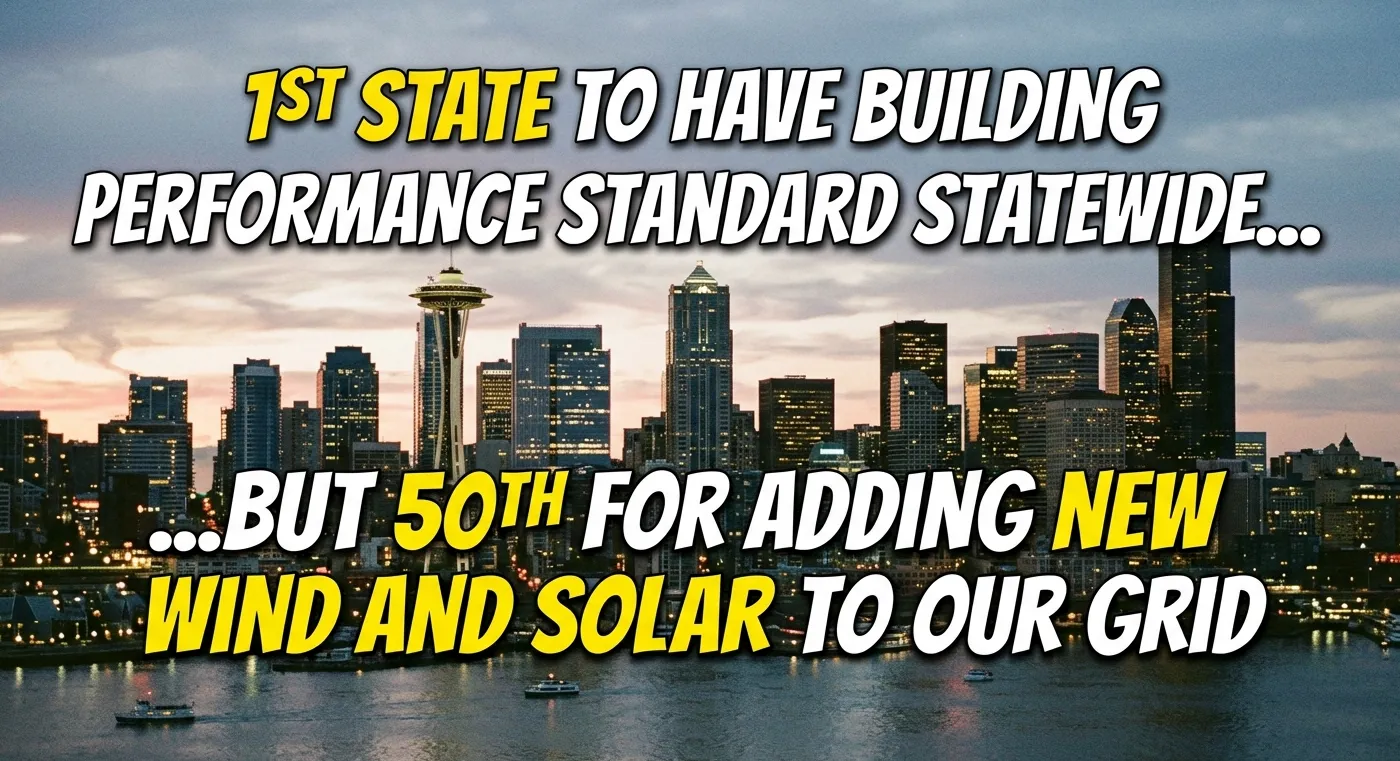
Washington has a proud climate reputation, and mostly a deserved one. We were the first state in the country to pass a building performance standard, a law that pushes our buildings to waste less energy. On the demand side of clean energy, we genuinely lead.
So the second number is hard to square with the first. According to a 2025 investigation by Oregon Public Broadcasting and ProPublica, Washington ranks 50th out of 50 states for adding new wind and solar to its grid. On the supply side, we are dead last.
I want to be precise, because that statistic gets misread. Our electricity is already remarkably clean; most of it comes from hydropower. The problem isn't how clean the grid is today. It's how little new clean power we are building for tomorrow, at the exact moment demand is climbing faster than it has in a generation.
I spent a good while trying to understand how a state this committed to climate could fall to last place. The answer turned out to be more specific, and more fixable, than the usual explanations. It isn't a lack of ambition, or projects, or wind and sun. It's structural, and most people have never heard the real story. Here it is, start to finish, along with where I land: we should not be 50th, and we don't have to be.
It's the wires, not the will
When you go looking for the cause, the tempting answers, weak political will, too much red tape, nobody wanting a project nearby, all fall short. Washington has the mandates, the developers, and some of the best wind and solar resource in the country. The projects are lined up and waiting.
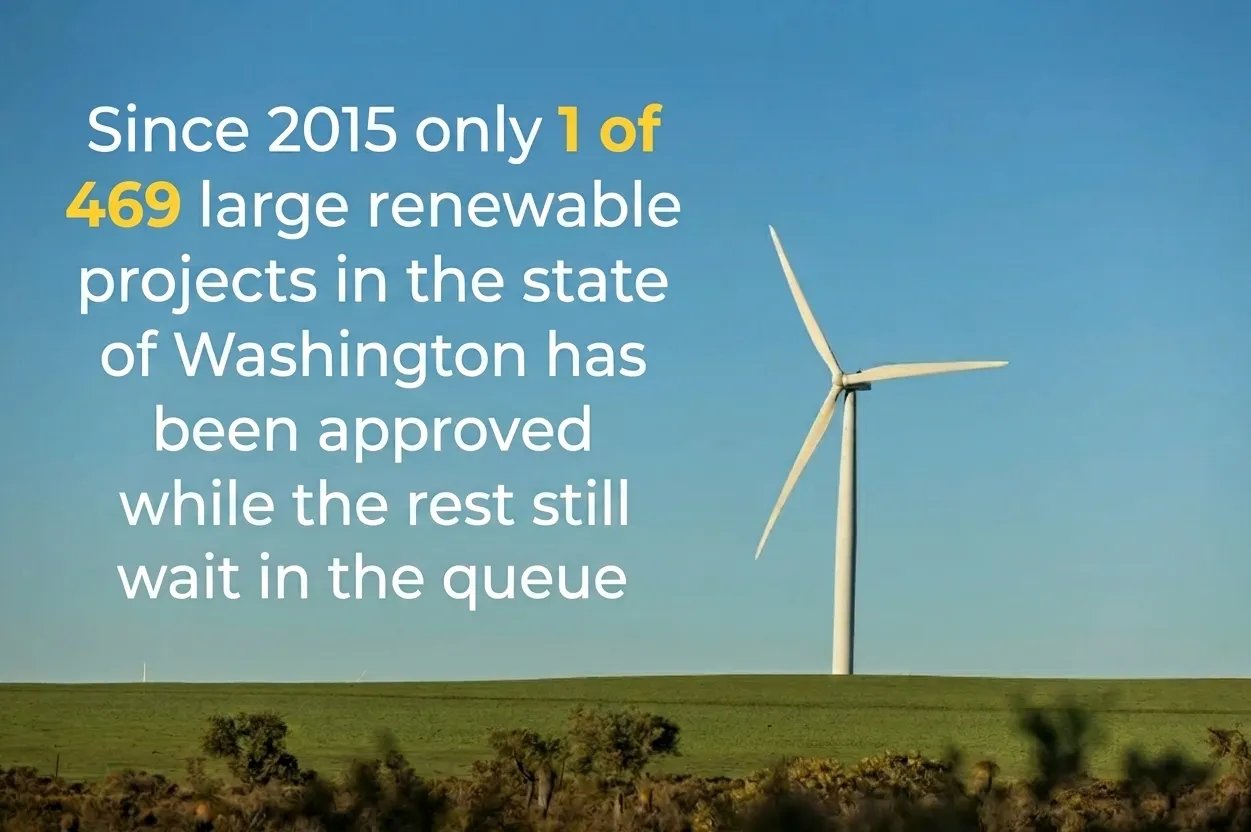
What they are waiting on is transmission: the high-voltage lines that carry power from where it is generated to where it is used. And here the numbers are stark. Since 2015, 469 large renewable projects have applied to connect to the region's main grid. Exactly one has been approved. That is a success rate of 0.2%, the worst of any region in the country. For comparison, roughly 10% make it through in the Midwest and 28% in Texas. More than 200,000 megawatts of wind and solar sit in the queue, enough to power the Northwest many times over, and one wind farm has been waiting more than sixteen years.
Most of those wires belong to a single entity: the Bonneville Power Administration, which owns about three-quarters of the region's transmission grid and decides which projects connect and how fast the system expands. Between 1960 and 1990, Bonneville built more than 4,800 miles of high-voltage line. In the past five years, it built one mile.
So this is not really a story about willpower. It is a story about one aging piece of infrastructure and the institution that runs it.
We're still paying for a 1970s mistake
It would be easy to cast Bonneville as the villain. The truer story is stranger, and more human: much of what holds us back today traces to a decision made fifty years ago.
Bonneville is a self-funded federal agency. It receives no annual tax money, borrows against its own revenue, and is required by law to recover every dollar from the customers who pay its bills. That alone makes it cautious. But there is a deeper reason it fears debt. In the 1970s, the region bet heavily on a set of nuclear plants that were never finished, and the bonds behind them defaulted, one of the largest public-power defaults in American history. Bonneville is still paying that debt down today.
An institution burned that badly learns to avoid risk at almost any cost. As Bonneville's own vice president of transmission planning put it, "We can't speculate and build a transmission line to nowhere." Even after Congress doubled the agency's borrowing authority in 2021 specifically to fund transmission, it has been slow to use it.
That caution shows up in a second way, one that quietly kills projects. When a new wind or solar farm needs the grid upgraded in order to connect, Bonneville largely requires that single developer to pay for the upgrade, and to put money down up front, even though the stronger grid will serve many customers for decades. One Oregon solar developer watched the required cost of his upgrade climb from $23 million to $70 million to $212 million across three studies. Faced with a bill like that, most developers simply walk away. (These findings come from the same Oregon Public Broadcasting and ProPublica reporting.)
It is worth naming one more quiet factor: our power has been so cheap, thanks to those federal dams, that for years there was little financial pressure to build anything new. Cheap and abundant is a wonderful thing, right up until it lulls you into standing still.
Put it all together and the picture is not villainy or laziness. It is today's generation managing the consequences of an old mistake, inside rules written for a different era. You do not fix that by blaming the people. You fix it by changing the structure. And structures can be redesigned.
What it's already costing us
None of this is abstract. It is already showing up in ways every Washingtonian can feel.
The first is reliability. Multiple studies now warn that the Pacific Northwest could face rolling blackouts within the next five years. The scenario planners fear most is specific: a hard cold snap in a low-snowpack winter, when demand spikes just as the rivers that power us run low. We have papered over the gap so far by buying electricity from elsewhere during extreme weather, often at a premium, but that only works until everyone around us needs it at the same time.
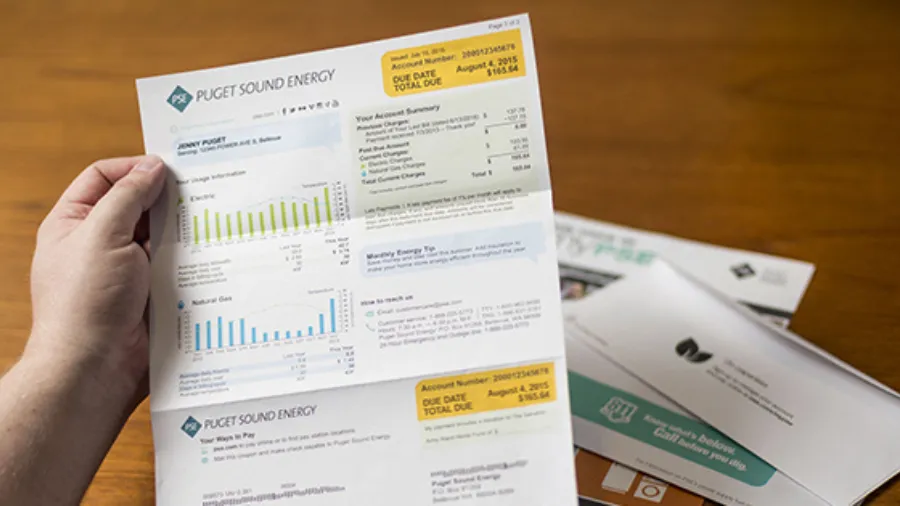
The second is cost. Puget Sound Energy raised electric rates about 12% in 2025 and roughly 6% more in 2026. Seattle City Light is raising rates around 5.4% a year. Tacoma Power customers will pay about $13 more a month by the end of 2026. Rate increases have many causes, and I would not blame all of it on one thing, but part of the story is simple: when you don't add enough of your own affordable power and demand keeps climbing, you end up buying on the open market at peak prices, and those costs land on customers. The failure to build isn't free. We are paying for it one bill at a time.
There is a human cost, too. We spent years telling people that clean energy was where the good jobs would be, and many trained for exactly that. Today, unemployment in Washington's electrical workers' union is running near 16%, about three times the statewide average, as skilled workers wait on a buildout that keeps stalling at the interconnection queue.
The fix already exists
Here is the part that shifted my mood from frustration to something closer to resolve. We do not need to invent a solution. One already exists, and it comes from an unlikely place.
First, the humbling comparison. Iowa, a state with roughly Oregon's population and similar wind, has built about three times as much wind power. Texas, the country's oil and gas capital, added more renewable energy last year than the entire Pacific Northwest uses. The places out-building us on clean energy are often the ones with the least green reputation.
Texas is worth studying, because two decades ago it had our exact problem. Its best wind was stranded in the remote west, and much of it was being wasted because the wires couldn't carry it. Instead of making each developer solve that alone, Texas designated renewable-energy zones and then built the transmission to reach them, deliberately, ahead of demand. The result was more than 2,300 miles of new line, energized by 2014. Wind that used to be curtailed at 17% fell to under half a percent, and Texas went on to become the nation's largest producer of wind and solar.
Strip away the politics and the lesson is simple. Build the wires first, in the areas with the best resource, and spread the cost across everyone who benefits rather than loading it onto one project. That is almost the exact opposite of how we have operated, and it is the direction we need to move.
The fastest fix is the one we're best at
There is another fix, and it happens to be the one I have spent my career on: the demand side.
The cheapest, fastest clean power isn't power at all. It's the demand a building never creates. This is not a slogan. The region's own draft power plan counts energy efficiency as a core resource, roughly 1,060 average megawatts of it over the next five years, capacity that arrives without a single new transmission line, permit fight, or interconnection queue. Set that against everything above: while new supply waits years for wires that may never get built, efficiency delivers now, and it sidesteps the very bottleneck that has us stuck at 50th.
It goes further than using less. A building that can shift when it uses power, easing off during a cold-morning peak, becomes a resource the grid can lean on. Coordinate enough of them and you have what's called a virtual power plant, built out of buildings we already have. Even the biggest new source of demand can help: data centers can run flexibly during peak stress, and Washington now requires them to meet a rising share of their power with new clean generation rather than pushing the cost onto everyone else.
The supply side is finally moving, too. In 2026 Washington created a new Electric Transmission Authority whose actual job is to plan and finance the lines the region needs, a clear owner where there wasn't one before. And there is growing momentum to get more capacity out of the lines we already have, by upgrading them with advanced conductors instead of always building new. Those changes matter. They also take years, which is exactly why the demand side, the part we can start today, matters so much.
Where Pilotlight fits
I don't come to this as a neutral observer either. The demand side of this story is the work we do every day at Pilotlight, and the alignment is worth naming.
At Pilotlight, we're a building compliance and decarbonization platform. We help building owners, and the teams that serve them, meet performance standards like Washington's Clean Buildings law, and cut and shape how much energy their buildings use, through benchmarking, deadline and compliance tracking, upgrade planning, and pulling incentives and paperwork into one place. In a supply crunch like this one, that isn't a side activity. Every building we help use less, or flex when it uses power, is capacity the strained grid doesn't have to build.
That is the throughline of this whole piece. While transmission catches up over years, the fastest clean capacity is the demand a building never creates, and making that practical at scale is exactly what we are built for. Policy and new wires set the supply side in motion; platforms like ours help the demand side pull its weight now.
It is why we pay close attention to stories like this one, and why we will keep sharing them. Washington shouldn't be 50th, and getting off the bottom will take both halves: more clean supply, and far smarter demand.
The opportunity, and the stand
It would be easy to read all of this as a story of decline. I see it the other way. Everything we have failed to build is also everything we could still gain. One analysis found that the clean-energy projects already proposed in Washington could power around 7 million homes and add roughly $149 billion to the state's economy if we build them by 2035. This is not a story about sacrifice. It is stranded prosperity, waiting on the other side of a bottleneck we know how to clear.
So here is where I land, plainly. Being last is not a fact about our geography or our values. It is the result of our rules, rules built for a different era, shaped by an old mistake, and never updated for the moment we are in. None of that is destiny. We have the wind, the sun, the workers, the mandates, and the demand. We can build the wires, share the cost fairly, make the largest users pay their own way, and use every building far more wisely while we do it.
A state that led the country on clean buildings can lead on clean power too. The path is no longer a mystery. The best time to start was twenty years ago. The second-best time is now.
If you work on any piece of this, from the grid to the job site to the buildings themselves, I would genuinely like to compare notes. This is a problem we can actually solve, and I would rather help solve it than watch us stay 50th.
Sources
- OPB / ProPublica investigation (2025)
- OPB / ProPublica follow-up, incl. Clean & Prosperous 7M homes / $149B analysis (Jan 2026)
- KUOW, Washington's clean energy bottleneck (2026)
- Northwest Power and Conservation Council, draft Ninth Power Plan (2026)
- Bonneville Power Administration, Investor Relations / interconnection