Washington's Clean Buildings Performance Standard, Explained
The whole law fits in one sentence: how much energy does your building use, how much should it, and what are you doing about the difference? Who Washington's CBPS covers, what it actually asks of Tier 2 owners, and the one date to write down.
By Jeff Nichols
Washington's Clean Buildings Performance Standard fits in a single sentence.
In plain English: how much energy does your building use, how much should a building like yours use, and what are you doing about the difference?
That is the whole law, and everything else is detail about how you answer those three questions, who is allowed to help you answer them, and by when. But the detail matters, and one piece of it gets flattened almost everywhere I see this law described, so let's go through it properly.
Who this applies to
Washington's law covers two groups of buildings, and it calls them Tier 1 and Tier 2. Tier 1 is the large commercial stock, meaning buildings where the conditioned nonresidential, hotel, motel, and dormitory space adds up to more than 50,000 square feet, not counting the parking garage. Tier 2 is everything from 20,000 up to 50,000 square feet, plus multifamily residential buildings of any size above that floor.
That last part surprises people, because it means a large apartment building is Tier 2 rather than Tier 1 regardless of how large it gets. Statewide the two tiers together cover roughly 28,000 buildings, and about 18,000 of those are Tier 2.
We will spend a full post on the difference between them in a couple of weeks, because it is the most consequential distinction in this law and it deserves the room. For today, what matters is that the requirements are not the same for both.
What the law actually asks you to do
If you own a Tier 2 building, you have three assignments.
1. Benchmark the building. Measure and track its energy use over time. In practice this means putting at least twelve consecutive months of energy data into ENERGY STAR Portfolio Manager, which is EPA's free benchmarking tool and the industry standard nationally. That produces your building's weather-normalized energy use intensity, which is simply energy used per square foot per year. You then calculate the target a building like yours would be held to, and compare the two.
2. Create an energy management plan. A written document describing how your organization manages energy performance in the building, including what you intend to improve and when. There is no required template.
3. Implement an operations and maintenance program. A routine plan for keeping your building's systems running the way they are supposed to run, covering HVAC, lighting, controls and the envelope. There is no required template here either, and an existing program that meets the standard can be used. Commerce publishes a free Excel-based development tool if you would rather not start from scratch.
That is the list. Benchmark, plan, maintain.
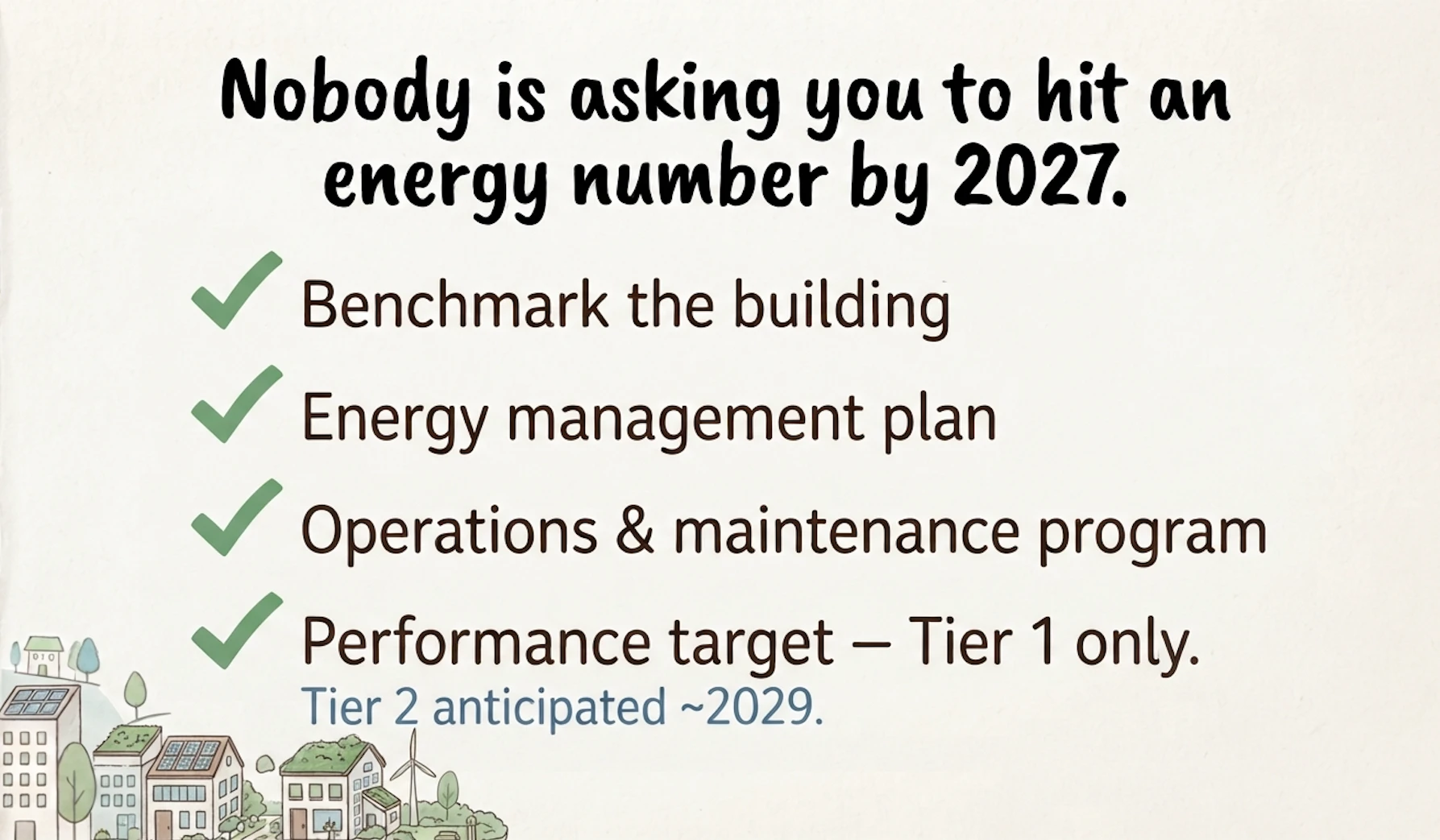
Here is the part that gets flattened everywhere, and it is the single most important thing in this post. You calculate that target, but you are not required to hit it. Commerce says so plainly: Tier 2 covered buildings are not required to meet the target at this time. Tier 1 buildings must meet theirs, or comply through an alternative investment pathway, while Tier 2 buildings work out the number, report it, and that is the obligation for this cycle.
Read that again if you own a Tier 2 building.
Nobody is asking you to hit an energy number by 2027. You are being asked to measure your building, find out what good would look like for a building like yours, and write down a plan. The obligation to close that gap comes later, and it will be written using what buildings like yours actually report between now and then. That is a genuinely different kind of project from the one most owners brace for, and it should change what this deadline feels like.
You are not expected to do this alone
The law does not assume building owners are energy engineers. For much of this work, the state requires a qualified person with specific credentials. A qualified person is the one who establishes your energy use targets where applicable and attests in writing that your energy management plan and O&M program have actually been developed, implemented and maintained, and professional engineers, certified energy managers and similar credentials qualify. Which is to say the state built this law expecting that most owners would hire someone. Bringing in a professional is not a failure to comply on your part. It's the design.
How to find out if this is you
On Tuesday I wrote about the owner who asked whether we were there to clean the building, and about why so many owners have never been told this law applies to them. Commerce sends its notices to the property taxpayer of record, and that is frequently not the person who would handle compliance.
You do not have to wait for the letter to find you. Commerce's Clean Buildings Portal has a Tier 2 Data Pool where owners confirm or deny ownership of the buildings the state has associated with them, and if a building you own is on that list, you are covered whether or not anyone told you.
Getting in takes two things: a Secure Access Washington account, which anyone can create, and a one-time access code. That code arrives in the building owner notification letter, which brings us back to the problem. If you never received one, Commerce publishes a form to request a notification letter or shared access directly. You do not need the letter to arrive on its own. You can go ask for it.
That is an afternoon of effort, and it removes the single largest source of confusion in this program before it costs you anything.
One date
For Tier 2 buildings, there is a single compliance deadline: July 1, 2027. Every Tier 2 building in Washington, same date.
There is a second date worth knowing now. If your building qualifies for an exemption, the application has to reach Commerce no later than 180 days before the compliance date, which closes that window on January 2, 2027. Exemption approvals also only cover the current compliance cycle, and owners have to re-certify within six months of the deadline that the building still qualifies. We will lay out every date in this law in Week 3, but for now those are the two to write down.
How Commerce is approaching this
It would be easy to assume a compliance deadline means a state agency waiting to fine you, and that is not what we have observed. Commerce runs free public office hours every month, publishes training videos and a full guidance library, and provides the standard itself at no cost. It has built exemption criteria, extension provisions and more than one pathway to compliance, and the 2026 rule update expanded that flexibility further by adding new exemption categories and additional ways to comply. None of that looks like an agency trying to catch people out. It looks like an agency that understands most covered buildings do not have an energy manager, and would rather have them comply than fine them.
One practical note while we are here: if you have an older copy of the standard, get the 2026 version, because the rules changed this year.
Where we fit
Pilotlight doesn't replace the building experts. We help those experts do their work at scale.
The engineers, energy managers, and mechanical contractors doing this work across Washington are good at it. What they have not had is infrastructure built for the volume of buildings this law covers, which is why so much of the early attention went to the largest portfolios. That is the problem we work on.
What to do next
If you own or manage a building over 20,000 square feet in Washington, three things, in this order.
Find out whether your building is covered. Get twelve months of energy data into Portfolio Manager. Talk to someone qualified about the plan.
You cannot fix what you cannot measure, and filling out forms was never the objective. Better buildings are the objective.
If I can be helpful to any of you as you work through this, reach out. And if you would rather hear it from the source, Commerce holds free office hours on the fourth Tuesday of every month.