Unplugged with Dawn Lindell: The Grid Ahead Runs on People
Former Seattle City Light CEO Dawn Lindell joined me at the 9Zero Climate Innovation Hub for a candid conversation about the grid ahead. What stayed with me most had less to do with technology and more to do with people.
By Jeff Nichols
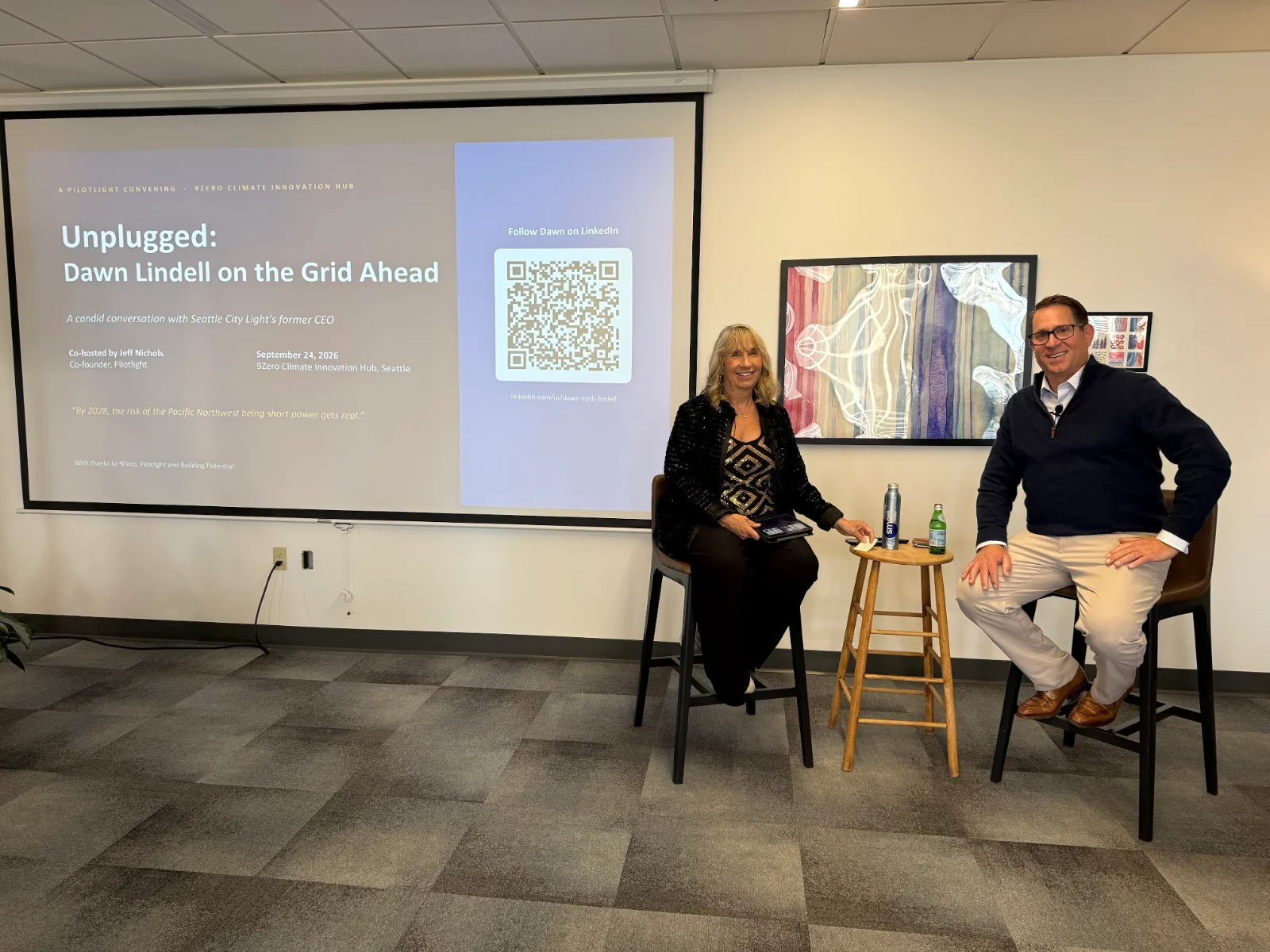
Last week I had the privilege of sitting down with Dawn Lindell, former CEO of Seattle City Light, in front of a packed room at the Seattle Climate Innovation Hub. Dawn and I first connected after she commented on one of my posts about the SCALE 2030 work. After one conversation with her, I told her we had to share what she was telling me with more people, because how the grid actually works and how utilities actually think is not well understood outside the industry. That conversation became this event.
I walked in expecting to learn about power markets and transmission, and I did. But what I keep coming back to is how much of what Dawn described had nothing to do with technology at all.
The squeeze is real, and it isn't only data centers
Dawn set the stage with two winters. Over Martin Luther King Jr. weekend in 2024, a five-day cold snap pushed Seattle City Light to a record of more than 2,400 megawatts, roughly double its normal load of about 1,200. With a key transmission line out of service, utilities across the region were bidding against each other for the same power, and Dawn said neighboring utilities spent $50 to $100 million over those five days. City Light actually came out $14,000 ahead, because Siobhan Doherty, its chief power marketing officer, and her team had planned ahead and had water to work with.
Then, in February 2025, the region set another record with no major weather event at all. Dawn was clear about why: transportation electrification, building electrification and ordinary growth. Most people assume the new load is all data centers. "That just isn't true," she said.
The number that stuck with me most came from a recent Seattle City Light forecast: the utility won't have enough baseload power to meet its average load, not just its peak, by 2028. That is two years away and the easy conservation is already done. As Dawn put it, the next round isn't changing a light bulb, it's changing a refrigerator... and nobody replaces a working refrigerator early.
That's an important distinction. The next efficiency gains live inside the buildings we already have, and capturing them takes planning, patience, and people who know the building.
The hard part isn't the technology
I often have said that technology is not the hard part, but the people and process, and Dawn has spent a career proving it.
When she arrived at Seattle City Light, the utility was six years into a stalled negotiation over the Skagit hydroelectric license with three tribal nations, four federal entities, and two state entities. Her fix wasn't a new model or a better spreadsheet. She got everyone into the same room, face to face instead of as little squares on a screen. They shared food, talked about their goals, and looked for where those goals lined up. Within a year they had hammered out the terms, and the license was signed this past December. "You can't come in and strong arm people," she said. "You have to bring them to the table and work through the conversation."
She told another story from her time at the Western Area Power Administration (WAPA) that I love. A young lineman came up to her in the field and said he flew drones for fun, and he thought drones could inspect the utility's steel lattice transmission structures. The veteran linemen thought the idea was ridiculous. Dawn listened, worked through the FAA requirements and backed it. An inspection that used to take six hours of climbing now takes about 30 minutes per structure. And once the veterans tried it, they wanted to fly the drones too.
So maybe we're asking the wrong question. The question isn't "what technology will fix the grid?" It's "who is in the room, and is anyone listening to them?" Dawn has a name for where good ideas get stuck: the frozen tundra of middle management. Leaders at the top often want change, and people on the front line have the ideas, but somewhere in between it gets lost in translation. Her advice was simple: To find the someone who solves your problem, be the someone who listens.
What climate-tech founders need to understand about utilities
A lot of people in that room are building technology that will eventually need a utility's cooperation, and Dawn was generous and candid with them. Before anything else, utilities think about two things: safety and reliability.
On safety, she gave a real example. Some companies are developing smart panels that manage how much power a home draws at once, and builders would like to run smaller wire to new homes that have them. Maybe that works. But if someone moves in, gets fed up and wires around the panel, an undersized wire can start a fire. So the answer is to pilot it, gather the data, and let the electrical code catch up once the evidence is there. On reliability, customers expect the lights to come on when they flip the switch, and every new technology gets measured against that expectation.
It would be easy to hear that as resistance to innovation, but it isn't.
It's what an enormous responsibility looks like from the inside. And Dawn was just as clear that utilities are "more ripe than ever before for innovation," especially for anything that makes them more efficient or brings down costs, because affordability is going to be a real challenge with all the investment ahead. Her practical advice for founders:
- Understand the utility's structure. Know where your product would actually benefit the utility, and who owns that problem.
- Call persistently. Get the number, make the call and say plainly that you think you can help.
- Show up where utilities gather, and don't sell. Get a booth at utility conferences, and if you get the chance to speak, talk about how the utility can save money or improve efficiency. Pitch from the stage and, in Dawn's words, "people will literally get up and leave."
Where Dawn finds hope
Near the end of our conversation I asked Dawn for some good news, and she didn't have to reach for it. The first thing she offered was a reframe on the topic everyone in the room was worried about: data center growth is coming whether we fight it or not, so utilities should negotiate for what their communities need.
Every large customer already pays for its own connection to the grid. Hyperscalers can also help pay for new generation, and if a utility is building power for them anyway, it might as well build enough to serve everyone's growth. Dawn even suggested negotiating a fund, paid for by the hyperscalers, to help customers who struggle to afford their electricity. "We hold the reins," she said.
The second source of hope was closer to home, and it's the one I think about most as someone who works on buildings. Seattle City Light has launched its first time-of-use rates, residential in May and commercial on September 23. In plain English: the grid peaks between 5 and 9 PM, right when people get home, turn on the lights and start cooking, and right when the solar power the region imports is going down with the sun. Customers who wait until after 9 to run the dishwasher or charge the car pay less. Dawn wants to go further, leasing space in people's garages for batteries that charge on cheap midday solar, keep a home running during an outage, and send power back to the grid during a peak.
That's a big deal. It means every building can be part of the answer, not just part of the load.
None of this happens quickly, and Dawn was honest about that. Idaho Power just put a 120-mile transmission line into service that it started trying to build more than two decades ago. Many of the rules that slow projects down were put in place for good reasons, but a timeline like that is one we can no longer afford, and changing it will take the same patient, face-to-face work she described with the Skagit license.
Why rooms like this matter
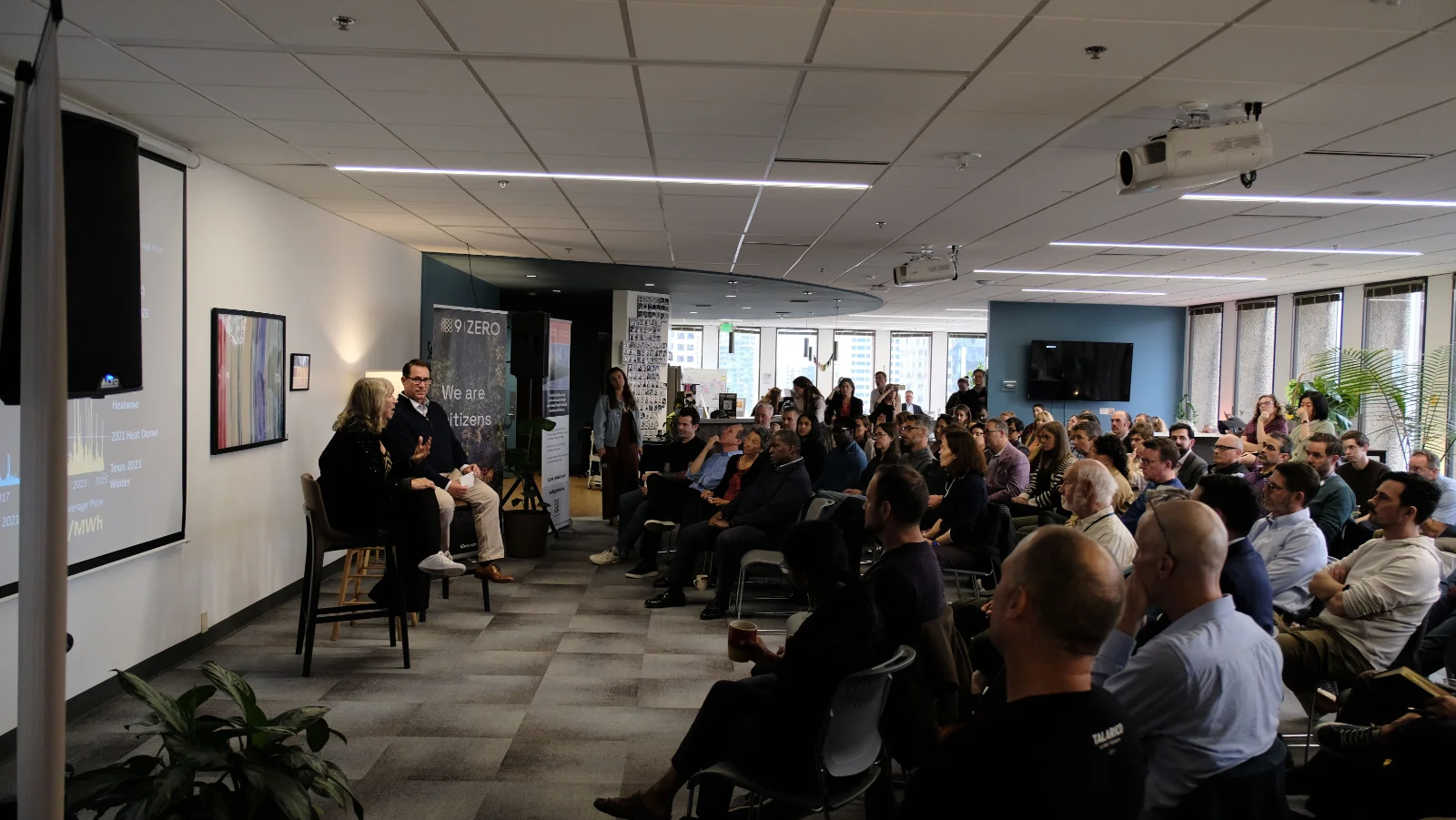
I found the Seattle Climate Innovation Hub about 18 months ago. It's a collaboration between the City of Seattle, UW CoMotion and 9Zero, and it has become a home base for people working on very different parts of the same problem. More than 100 people came out to hear Dawn, and their questions ranged from tribal partnerships and home batteries to small modular reactors and community concerns about battery storage. That range is the point.
We're facing challenges that no single startup, utility, regulator, or city can solve alone. Dawn made the case for partnership again and again, whether it was Seattle City Light, Puget Sound Energy and Bonneville building transmission together, or utilities showing up in communities to explain battery storage before a developer does. "People want to help. They want to do the responsible thing," she said. "They just don't understand. And we've got to help them understand."
I closed the evening by asking everyone to look around the room. No one was there by accident. The reality is that no one is coming to do this for us. It's us, and it starts with people.
Thank you
Thank you to Dawn for flying in and speaking so candidly. Thanks to the 9Zero and Climate Innovation Hub team for hosting, to Perry England and the Building Potential team for helping make the event happen, and to Sarah Wulf of Artemis for her work on Dawn's slides. If you'd like to watch the full conversation, the recording is here
As always, if I can be helpful to any of you in my network, please don't hesitate to reach out.