$0.30 Either Way: Washington's Tier 2 Early Adopter Incentive, Explained
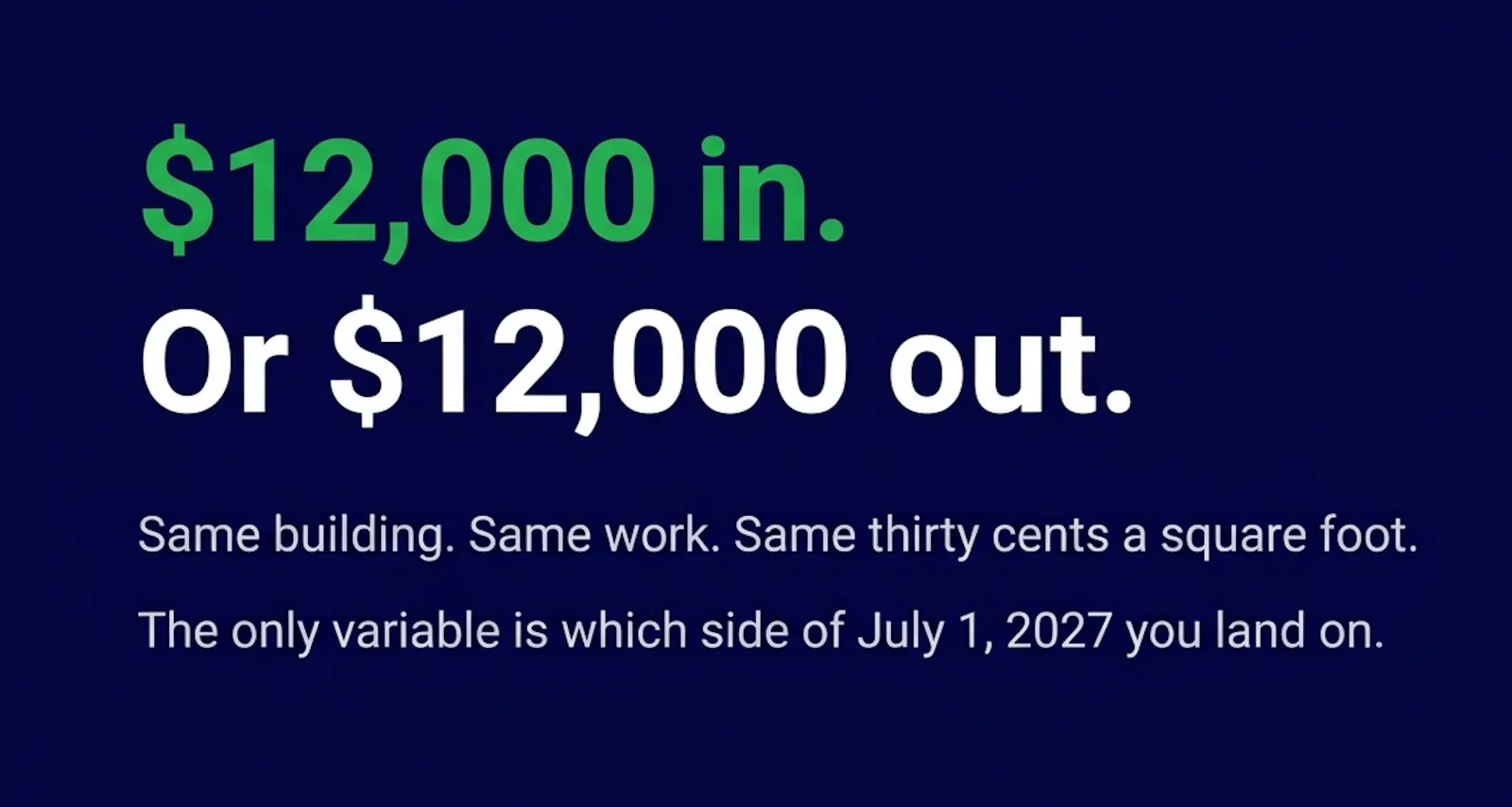
The maximum penalty for missing your Tier 2 deadline is thirty cents per square foot. The incentive for complying is also thirty cents per square foot. Same building, same work, same number, and the only variable is timing.
By Jeff Nichols
Last week I wrote about what happens if your deadline passes without you. The maximum administrative penalty for a Tier 2 building is thirty cents per square foot.
Here is the same number, pointing the other way.
The base Tier 2 Early Adopter Incentive is thirty cents per square foot, paid to owners who complete the compliance work Washington already requires of them.
Same building. Same work. Same number. The only variable is whether you move before the deadline or after it.
On a 40,000 square foot building, that is twelve thousand dollars arriving versus twelve thousand dollars leaving. A twenty-four thousand dollar swing, decided by timing alone.
We think that's a pretty easy decision.
What the program actually is
The Tier 2 Early Adopter Incentive Program launched July 1, 2025. Washington allocated $150 million to it, to be paid out through participating utilities to building owners who demonstrate compliance with the Clean Buildings Performance Standard.
As of September 2026, Commerce reports roughly $7.3 million awarded. More than $142 million remains.
That’s not a typo as less than five percent of the fund has been claimed, ten months out from the deadline that makes every Tier 2 building in the state eligible.
However, I do not expect that to last.
What you have to do to earn it
This is the part that surprises people, so I want to be plain about it.
You do not have to install anything. You do not have to hit an energy target. You do not have to complete a capital project.
The incentive is paid for completing the three things Tier 2 compliance already requires: benchmarking the building, implementing an operations and maintenance program, and creating an energy management plan.
That is it. The state is offering to pay you for doing the thing you are legally obligated to do anyway.
Which tells you something about how Washington views this program. If the goal were revenue, you would not pay people to comply.
Two things that change the number
Before you multiply your square footage by thirty cents, two adjustments.
- Not all of your square footage counts. The incentive is calculated on gross floor area excluding parking, and excluding unconditioned and semi-conditioned spaces. A building with a substantial garage or warehouse area will see a smaller number than a straight square footage calculation suggests.
- You need a participating utility. Eligibility requires being served by at least one participating electric utility, gas company, or thermal energy company. Utilities with more than 25,000 customers are required to participate under RCW 19.27A.240. Smaller utilities participate voluntarily, and utilities that do not pay public utility taxes are not eligible at all. Worth checking the participating list before you count on this.
- And you can forfeit it. An owner who receives a notice of violation and responds by choosing to pay the penalty rather than pursuing compliance may not be eligible to apply for the incentive at all. Complying late keeps you in. Paying to make it go away does not. Neither of those is a reason not to look, they’re the reason to work out your actual number rather than a rough one.
The enhanced rate, if you qualify
In 2024, House Bill 1976 created an enhancement that raises the incentive to seventy-five cents per square foot.
It is narrower than the base program. It applies to owners who rent or lease to residential tenants and are willing to sign an Anti-Displacement Agreement, committing to measures that protect existing tenants. If you qualify, you qualify regardless of where in Washington the building sits.
One mechanical detail worth understanding: the enhanced incentive pays seventy-five cents per square foot or the listed cost of compliance, whichever is lower.
Read that carefully, because it tells you what the state expects. Commerce built the calculation on the assumption that for some buildings, the cost of complying will come in under the check. That is a program designed to make compliance free for the buildings least able to absorb the cost.
How to actually claim it
The sequence matters, and it is simpler than people assume.
Compliance and incentive applications both go through the Clean Buildings Portal. You submit them together, Commerce reviews and certifies your building as compliant, and your utility pays you.
So the order is: do the compliance work, apply for both at once, get certified, get paid.
Two mechanical details worth knowing before the money arrives.
The payment comes from your utility, not from Commerce. Commerce reviews the application and certifies the award; your utility issues the check and then claims a tax credit for having made it. Practically that means you may need to give your utility a W9, and the amount is calculated on your proportion of energy use by fuel type.
And ask your accountant about tax treatment before you budget the full figure. Commerce publishes a Department of Revenue factsheet on the program. I am not going to give you tax advice, but a payment arriving from a utility is worth a conversation before you assume all of it is yours.
Commerce is explicit that both applications are due by July 1, 2027, so treat that as the date for the incentive as well as for compliance.
But July 2027 isn't really the deadline that decides whether you get paid, and this is the part worth understanding.
The money is finite and it's first-come, first-served. The legislature appropriated $150 million, roughly 18,000 buildings are eligible, and all of them are clearing a single compliance deadline on the same day. Commerce's own guidance is to comply and apply early to ensure funding is available.
There's a calendar deadline and there's a money deadline, and the money one arrives first. The fund closes when it's empty, whenever that happens to be.
The arithmetic, one more time
Act early: the work gets done on your schedule, with your choice of provider, and a check arrives for up to thirty cents a square foot. Seventy-five if you are multifamily and sign the agreement.
Wait: the work still gets done, on a compressed schedule, competing for the same finite pool of qualified professionals, with a penalty of up to thirty cents a square foot instead of a payment.
Same number, opposite direction.
Where we fit
One thing worth saying plainly here, the incentive only pays out on completed, certified compliance. The gap between a building that intends to comply and a building that has documentation approved by Commerce is administrative work, and administrative work is what eats the margin out of serving smaller buildings. That’s the problem we exist to solve.
What to do next
Check whether your utility participates. Find out what your eligible square footage actually is. And if you are a multifamily owner, look hard at the anti-displacement enhancement, because it more than doubles the number.
Understand the building. Get the data. Build the plan. Take advantage of the incentives while they're available.
Next week, the post for everyone who read all of this and thought: I don't want to do any of it myself. Good news. You mostly shouldn't.
If you want help figuring out what your building qualifies for, reach out.
Sources
- Washington Dept. of Commerce, Tier 2 Early Adopter Incentive Program (program scope, $150M allocation, funds awarded, enhanced incentive, utility payment process, W9, fuel-type calculation)
- RCW 19.27A.220, as amended by SHB 1543 (2025) (incentive authority, base and enhanced amounts)
- Washington Dept. of Commerce, CBPS Grants and Incentives (portal application process, utility tax credit mechanism)
- Washington Dept. of Commerce, CBPS Tier 2 compliance (three compliance requirements, July 1 2027 deadline)
- RCW 19.27A.240 (utility participation requirements)
- Washington Dept. of Commerce, Clean Buildings Early Adopter Incentive Legislative Report (program funding structure)