Tier 1 vs. Tier 2: The Big Buildings Came First. Now Comes the Long Tail.
Washington's Clean Buildings Performance Standard covers roughly 28,000 buildings. About 18,000 of them are Tier 2, and most don't have a facilities team. Here's what separates the two tiers, what Tier 2 owners actually have to do, and why July 2027 is closer than it looks.
By Jeff Nichols
The easiest way to understand Washington's Clean Buildings Performance Standard is pretty simple:
Tier 1 is the really big buildings. Tier 2 is the smaller buildings.
But the difference between the two tiers goes well beyond square footage. They represent two different phases of Washington's effort to understand, and ultimately improve, the performance of our existing buildings.
And right now, we're at an important transition point. This is the fifth lesson in our Back to School series on the Clean Buildings Performance Standard, and it's the one that decides which set of rules is actually yours.
Tier 1: The Big Buildings Came First
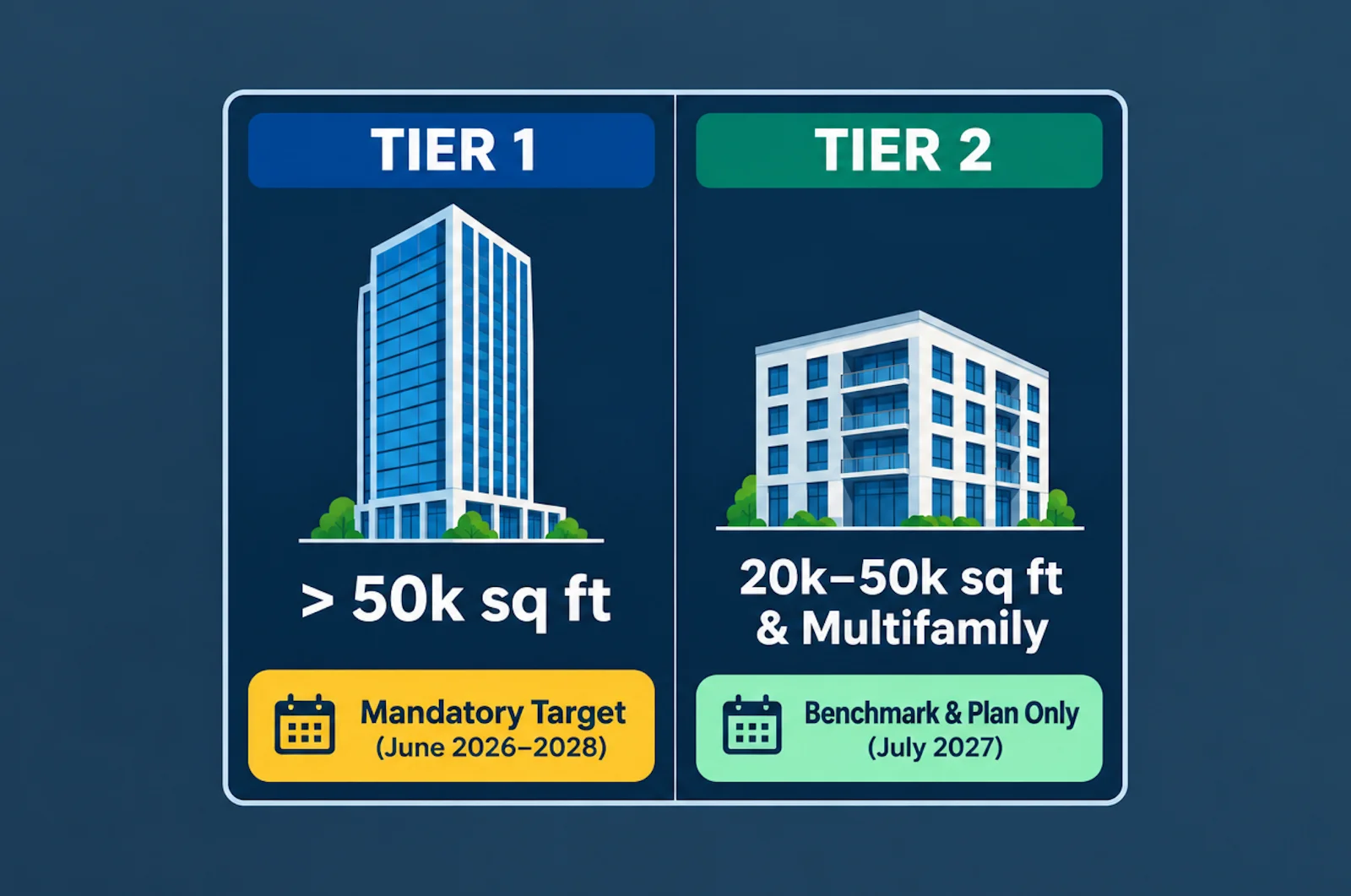
Tier 1 generally covers nonresidential buildings over 50,000 square feet. Think universities, hospitals, large office buildings, schools and other major facilities.
Because these buildings are larger and generally have more sophisticated facility-management teams, Washington started here.
Tier 1 compliance is being phased in by size, according to the Department of Commerce:
- Buildings over 220,000 square feet: June 1, 2026
- Buildings over 90,000 through 220,000 square feet: June 1, 2027
- Buildings over 50,000 through 90,000 square feet: June 1, 2028
So the first Tier 1 deadline has already passed, and attention is now shifting toward the next two groups.
Tier 1 is a true building-performance standard. Owners need to benchmark energy use, establish an Energy Use Intensity target (an EUI target), implement an energy-management plan and an operations and maintenance program, and then demonstrate they've met a performance metric through one of the compliance pathways the state makes available.
That can get complicated quickly.
The state therefore establishes qualifications for the professionals performing much of this work. Depending on the role, Commerce requires a qualified person, a qualified energy auditor, or a qualified energy manager, and it maintains public directories to help owners find them. These are credentialed building-energy professionals: professional engineers, Certified Energy Managers, and others with comparable training.
This is also where companies like Pilotlight fit into the ecosystem.
Pilotlight doesn't replace the building experts. We help those experts do their work at scale.
We provide the software infrastructure that mechanical contractors, energy consultants and other building-performance professionals use to organize information, manage workflows and complete compliance efficiently.
Because ultimately, filling out forms isn't the objective, better buildings are the objective.
The less time qualified professionals spend chasing documents, manipulating spreadsheets and managing administrative processes, the more time they can spend identifying and implementing improvements in the buildings themselves.
Tier 2: Now Comes the Long Tail
Tier 2 changes the scale of the challenge.
These are generally buildings between 20,000 and 50,000 square feet, plus multifamily residential buildings over 20,000 square feet at any size. That last part is worth pausing on. A large apartment building is a Tier 2 building even when it's well above 50,000 square feet, which surprises a lot of owners.
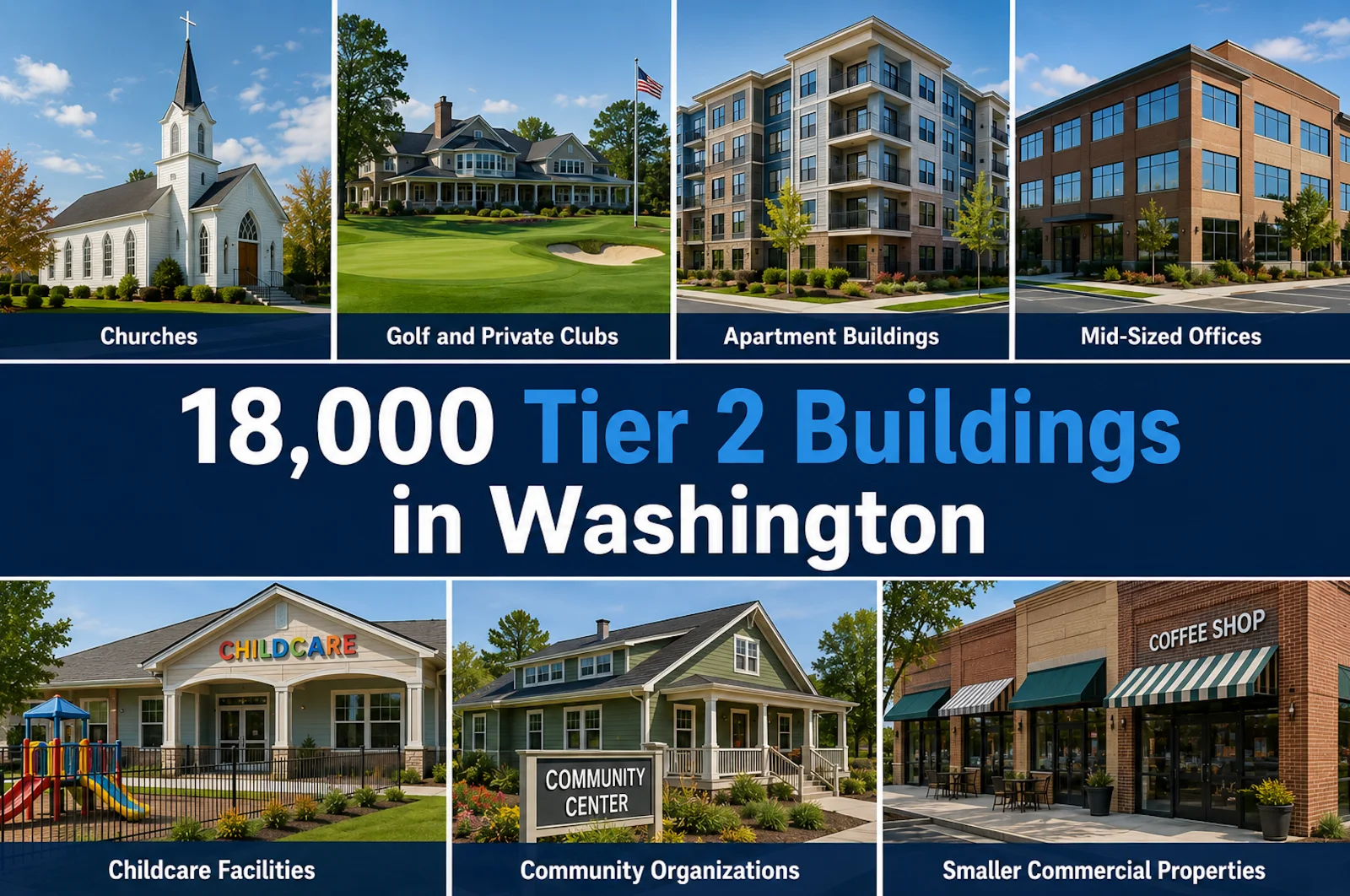
Think churches, golf and private clubs, apartment buildings, mid-sized offices, childcare facilities, community organizations, and smaller commercial properties.
These aren't necessarily organizations with full-time energy managers or sophisticated facilities departments.
And there are a lot of them. Across the two tiers, roughly 28,000 Washington buildings fall within the Clean Buildings program, with approximately 18,000 in Tier 2. That's why we view Tier 2 as such an important phase of the program.
What Tier 2 Requires Today, and What Comes Next
Tier 2 buildings must report compliance by July 1, 2027. Their requirements include energy benchmarking, an energy-management plan, and an operations and maintenance program. Current rules also require owners to establish and report an EUI target. You calculate what a building like yours should be using, you compare it against what your building actually uses, and you report the gap. Commerce is explicit that Tier 2 buildings are not required to meet that target at this time.
The comparison is the deliverable. The gap is the point: it's the data the state will use to write the Tier 2 performance standard later.
That's an important distinction.
Tier 1 is largely about performance. Tier 2, at this stage, is largely about understanding and managing performance. And that's a logical place to start.
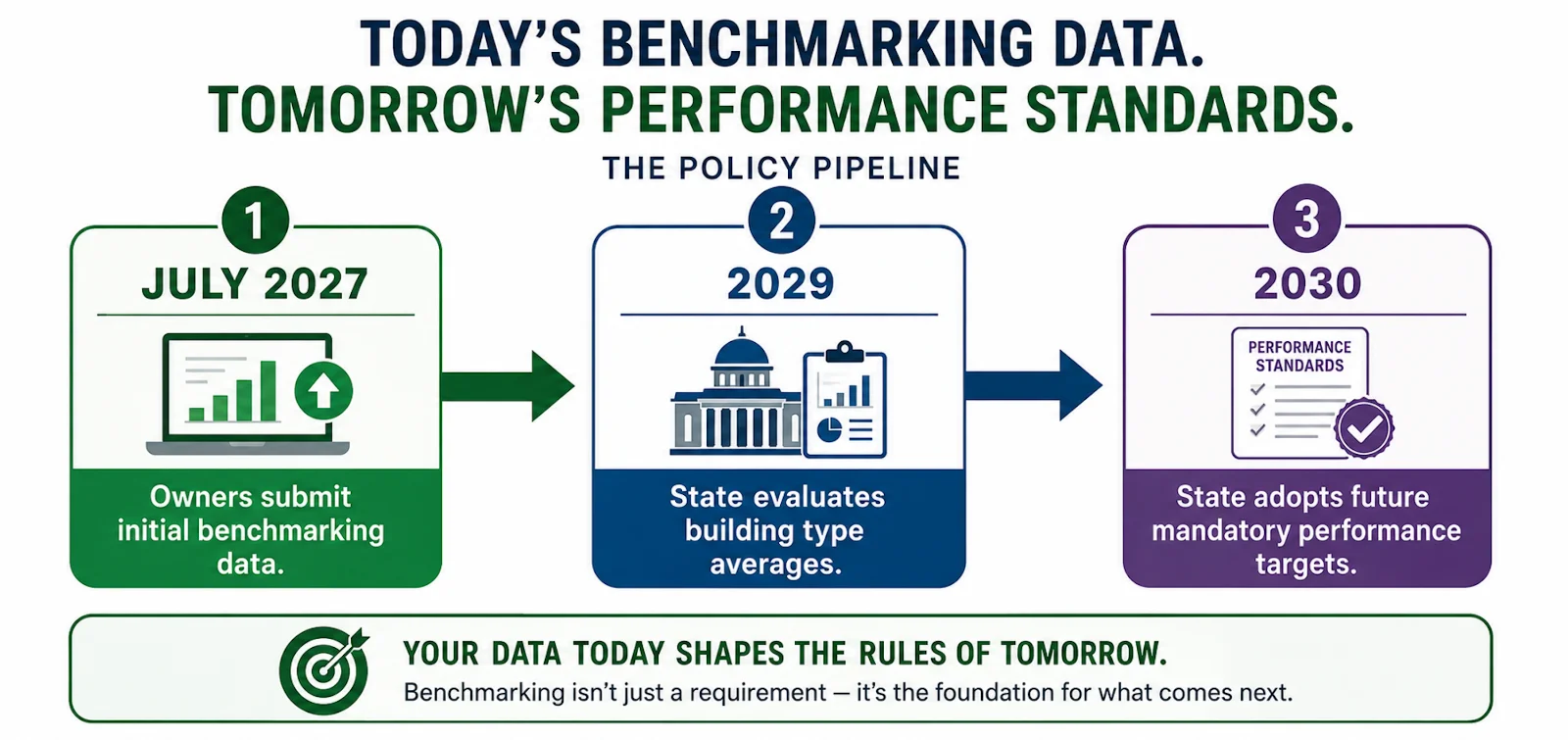
It's also worth understanding why "at this stage" is the right phrase, because the law lays out what comes after. When the legislature expanded the Clean Buildings Act in 2022, it wrote a sequence into statute. Commerce adopted the benchmarking, energy-management and O&M requirements in 2023. Tier 2 owners report for the first time in 2027. Then, on the current schedule, Commerce evaluates that benchmarking data in 2029 to determine energy use and emissions averages by building type, and must adopt performance standards for Tier 2 buildings by the end of 2030, with those rules taking effect no earlier than the close of the 2031 legislative session.
Read that sequence again and notice what it actually means.
The data Tier 2 owners submit in 2027 is the raw material the state will use to write the targets those same buildings eventually face. Benchmarking isn't a formality on the way to the real requirement, it's how the real requirement gets written.
The law builds in some flexibility as well. Commerce is directed to consider the age of a building when setting those future targets, and it may put multifamily buildings on a longer timeline than the rest of Tier 2. The legislature clearly understood that the long tail needs a gentler on-ramp than the largest buildings got.
Timelines can move, and this one has been debated before, but the direction is set.
Why Tier 2 Owners Should Act Now
July 2027 might sound like a long way away, but it isn't.
Utility data needs to be gathered, buildings need to be benchmarked, equipment and operating practices need to be understood, plans need to be created, and Documentation needs to be assembled, reviewed and submitted.
Doing that across thousands of buildings takes time.
There's also an earlier deadline that's easy to miss. If you think your building might qualify for an exemption, the application has to reach Commerce no later than 180 days before your compliance date. For Tier 2 buildings, that means January 2, 2027. An owner who works that out in the spring of 2027 will have missed the window by months.
There's a third door, and it's the one most owners don't know about. The standard grants a two-year extension to an owner who has completed the benchmarking but not the rest of it, specifically to finish the energy management plan and the O&M program.
The application window runs from six months before your compliance date to six months after it. Read the back half of that again. You can apply for an extension after your deadline has already passed.
It isn't indefinite. When the two years run out you have to demonstrate compliance or file for an exemption, or the penalties come back into play.
But between exemptions, extensions and that provision, the state has built three separate ways to stay in good standing without meeting every requirement on schedule. That isn't the behavior of an agency looking for reasons to fine people.
And if your building is in Seattle, there's a second clock running. Seattle's Building Emissions Performance Standard covers nonresidential and multifamily buildings over 20,000 square feet, so a Seattle Tier 2 building answers to both the state standard and the city's. We went through both laws side by side earlier in this series, so I won't repeat it here.
The encouraging part is that BEPS was designed to complement the state program rather than duplicate it, using the same qualified-person credentials and the same Energy Star Portfolio Manager profile. And the timing is gentler than most owners assume: a Tier 2 building doesn't face its first BEPS deadline until October 2029 or October 2030 depending on size, well after the state's July 2027 date.
The work you do next year is the foundation for both.
Washington has also created a significant reason for Tier 2 owners to move early: the Tier 2 Early Adopter Incentive Program.
Eligible owners can receive a base incentive of $0.30 per square foot for completing the applicable benchmarking, energy-management and O&M requirements. Certain multifamily properties committing to anti-displacement provisions may qualify for an enhanced incentive of as much as $0.75 per square foot.
The state allocated $150 million to the Tier 2 incentive program. As of September 2026, Commerce reports that about $7.3 million had been awarded and more than $142 million remained available. Incentives are administered through participating utilities on a first-come, first-served basis.
That's a big deal.
Depending on the building and the provider selected, the incentive can materially offset the cost of preparing for compliance, and in some cases it can cover it outright. That isn't wishful thinking on our part. It's built into how the program calculates payments. The enhanced incentive pays $0.75 per square foot or the listed cost of compliance, whichever is lower, which tells you the state expects some buildings to comply for less than the check they receive.
Compare that with waiting.
The maximum Tier 2 administrative penalty for failing to submit the required compliance documentation is also $0.30 per square foot.
Same number, opposite direction.
For context, Tier 1 penalties are considerably steeper. Commerce assesses them at up to $5,000 plus $1.50 per square foot of gross floor area. On a 100,000 square foot building, that works out to roughly $155,000, compared with about $30,000 for a Tier 2 building of the same size. Tier 2 really is the gentler on-ramp, and the incentive is only available on the front end of it.
So building owners essentially have two very different paths:
Act early, understand your building and potentially receive an incentive.
Or:
Wait, miss the process and potentially pay a penalty.
We think that's a pretty easy decision.
This Isn't Supposed to Be a "Gotcha"
One thing we've learned working in this market is worth emphasizing:
The goal of the Clean Buildings program isn't to fine building owners.
Commerce provides technical assistance, training, monthly office hours, compliance pathways, exemptions and conditional-compliance mechanisms precisely because the objective is to get buildings engaged in the process. The agency says as much on its own website, where it describes its primary goal as fostering compliance rather than imposing penalties.
You can also watch it happen as the first Tier 1 deadline arrived in June 2026. Commerce spent that same year rewriting the rules behind the standard, and the stated purpose of that rulemaking was to adopt additional compliance pathways, expand the criteria for exemptions, and make it easier to approve extensions. The final version was filed in July 2026.
Read that sequence again. The state watched building owners work through the first real deadline, and its response was to make the standard more flexible, not less.
There has to be a consequence for simply ignoring the law, but enforcement isn't the interesting part of the program.
The interesting part is what happens when we finally understand our buildings.
Think about how unusual our existing building stock is.
A building might have been constructed 30, 50 or even 100 years ago. Boilers get replaced. Controls change. Tenants come and go. Additions are built. Maintenance teams change. Documentation disappears.
Eventually, nobody has a complete picture of what is actually there or how efficiently it operates.
Multiply that problem across tens of thousands of buildings and you begin to understand the challenge.
You Can't Fix What You Can't Measure
That's why we believe benchmarking matters.
Before deciding where to spend billions of dollars replacing equipment, electrifying buildings, adding renewable energy or expanding the electrical grid, we should understand which buildings use the most energy and where investment can produce the greatest return.
That's what building-performance standards begin to give us.
The scale of the opportunity is significant. A widely cited figure from the U.S. Environmental Protection Agency, which the Department of Energy also publishes, holds that on average 30% of the energy used in commercial buildings is wasted through inefficiencies.
Here in Washington, the stakes are more specific than that. Residential and commercial buildings are the state's second-largest source of greenhouse gas emissions, roughly a quarter of the statewide total, according to Commerce. And when the legislature passed the original Clean Buildings law in 2019, it found that emissions from the buildings sector had grown by 50% since 1990, far outpacing every other source in the state.
That's the problem this program was built to address.
And existing buildings can't be ignored. The International Energy Agency estimates that in advanced economies, roughly 80% of the building stock that will exist in 2050 has already been built.
That means we cannot build our way to a more efficient future.
We have to improve what we already have.
Pilotlight's View
There's no single technology that solves the building-energy or climate challenge.
It won't be solved by solar alone. Or wind. Or electric vehicles. Or heat pumps. Or batteries. Or some future breakthrough in energy generation like fusion.
All of those technologies can play a role, but so can something far less glamorous:
Making the buildings we already have work better.
That's why Pilotlight supports the basic idea behind building-performance standards. Not because compliance paperwork has inherent value, it doesn't.
The value is creating an orderly, transparent process that allows building owners, policymakers, utilities, engineers and contractors to understand the existing building stock, and then make smarter decisions about where limited capital and resources should go.
Tier 1 started that process with Washington's largest buildings.
Tier 2 takes it to the long tail.
And with approximately 18,000 Tier 2 buildings approaching a July 1, 2027 deadline, this is where the next chapter begins.
Our focus at Pilotlight is helping the mechanical contractors, energy consultants and other professionals serving those buildings make compliance simpler, faster and less expensive, so everyone can spend less time administering the program and more time improving buildings. We also work directly with smaller Tier 2 buildings, because we need everyone helping these smaller buildings get through the process.
If you're not certain which tier your building falls into, our compliance navigator will tell you in a few minutes. It's free and it asks nothing of you.
If you own or work with a Tier 2 building, now is the time to start.
Understand the building. Get the data. Build the plan. Take advantage of the incentives while they're available.
On Thursday, every date that matters, in one place.
And then let's get to work making our buildings better.
Sources
- Washington Dept. of Commerce, CBPS Tier 1 compliance (Tier 1 deadlines, qualified personnel, penalties)
- Washington Dept. of Commerce, CBPS Tier 2 compliance (Tier 2 requirements, exemption window, penalty cap)
- Washington Dept. of Commerce, Tier 2 Early Adopter Incentive Program (incentive amounts, funding remaining, payment process)
- Washington Dept. of Commerce, CBPS Support and Resources (qualified person, qualified energy auditor and qualified energy manager roles)
- Washington Dept. of Commerce, Clean Buildings Performance Standard (2026 rulemaking and CR-103 filing)
- Washington Dept. of Commerce, Rulemaking (purpose of the 2026 WAC 194-50 update)
- RCW 19.27A.250, Tier 2 covered buildings (benchmarking requirements and the 2030 performance standard deadline)
- RCW 19.27A.210, State energy performance standard (2019 legislative finding on buildings-sector emissions growth)
- Washington Dept. of Commerce, Clean Buildings Performance Standard Legislative Report, 2025 (buildings as a share of statewide emissions)
- Seattle Office of Sustainability and Environment, Building Emissions Performance Standard policy guide (BEPS scope, credentials and timeline)
- International Energy Agency, Breakthrough Agenda Report 2025, Buildings (80% of 2050 building stock already built)
- U.S. Environmental Protection Agency, ENERGY STAR (30% of commercial building energy wasted)
- U.S. Dept. of Energy, Commercial Buildings Integration Program (publishes the same 30% figure)