The Dates That Matter (Mark Your Calendar)
Every date in Washington's Clean Buildings Performance Standard and Seattle's BEPS, in one place. Including the three Tier 2 dates that come before the July 2027 deadline, and the one that closes first.
By Jeff Nichols
This is the post I would bookmark.
Everything else in this series is context. This is the part you actually need, and I want it in one place so nobody has to assemble it from six different agency websites.
One note before we start. Every date here is current as of October 2026, and some of them are revisable by rule. I have said so where that applies. If you are reading this a year from now, check the source links at the bottom.
Washington Clean Buildings: your compliance deadline
- Tier 1, over 220,000 square feet: June 1, 2026 (passed)
- Tier 1, 90,001 to 220,000 square feet: June 1, 2027
- Tier 1, 50,001 to 90,000 square feet: June 1, 2028
- Tier 2, 20,001 to 50,000 square feet: July 1, 2027
- Tier 2, all multifamily over 20,000 square feet: July 1, 2027
Then every five years after your first deadline.
If you own a Tier 2 building, that is the date. There is no size-based phasing inside Tier 2. A 21,000 square foot church and a 300-unit apartment building report on the same day.
The three Tier 2 dates that come before the deadline
This is the part that catches people, because the July date is not actually the first one that matters.
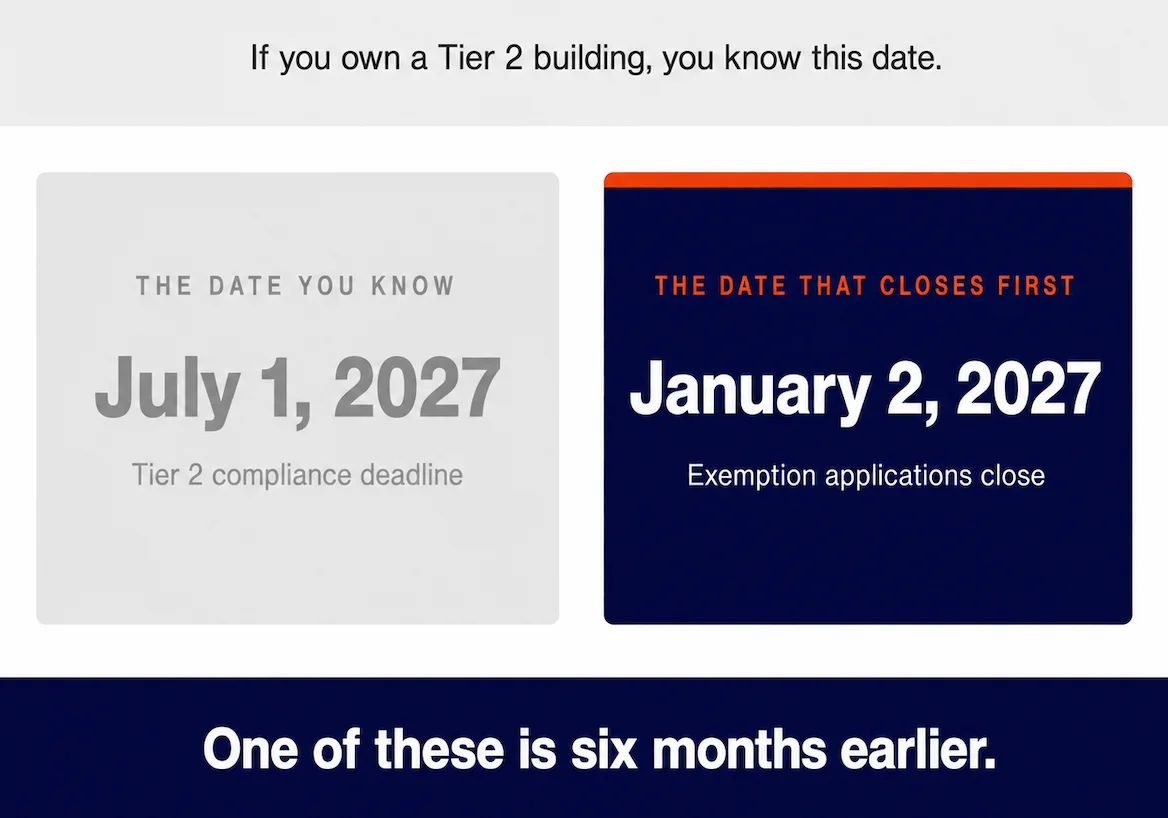
January 2, 2027: exemption applications close
The standard is precise about this. Applications may be submitted no sooner than two years before your compliance date and no later than 180 days before it (Annex Y, Section Y3.2.3). For Tier 2, 180 days before July 1, 2027 is January 2. Give yourself December, because an application that arrives on January 3 is late.
An owner who works this out in the spring of 2027 has missed the window by months, and that date is roughly twelve weeks from the day this posts.
January 1, 2027 to January 1, 2028: the extension window
Extensions came in with the 2026 rulemaking and give a two-year delay on your compliance date. The application can be filed from six months before your compliance date to six months after it. For Tier 2 that means the window opens at the start of 2027 and stays open through the end of it.
Worth understanding what that means. Your July 1, 2027 deadline is not the last date at which something can be done. It is the last date at which doing nothing is still free.
July 1, 2027: your compliance deadline
File the incentive application alongside it. Strictly, the incentive window is wider than the compliance window: under RCW 19.27A.220 tier 2 owners can apply from July 1, 2025 all the way through June 1, 2030. But the fund is fixed and first-come, first-served, so it will run dry long before the window closes. Treat July 1, 2027 as the date for both.
Already open, and worth knowing: early compliance and incentive applications for Tier 2 opened July 1, 2025, and that early-compliance option expires June 1, 2027. You can file any time between now and then.
One window, rather than a date
Worth knowing alongside the deadlines. The standard requires at least twelve consecutive months of energy data, monitored within the two years before your compliance date. For Tier 2, that puts your usable data window at roughly July 2025 through July 2027.
For most buildings that is good news, because the data already exists and your utility is legally required to hand it over. It becomes a problem if the building changed hands, if meters were reconfigured, or if a stretch of vacancy left gaps in the record. All of those are fixable now. None of them are fixable in June.
You will also hear that your O&M program has to run for twelve months before your deadline. That is not what the rule says, and for Tier 2 it does not apply at all, since Tier 2 buildings are not required to meet a target this cycle.
What happens after 2027
Tier 2 owners are not required to meet an energy target this cycle. That obligation is coming, and the statute lays out the sequence.
On the current schedule, Commerce evaluates the benchmarking data Tier 2 buildings submit in 2027 to determine energy use and emissions averages by building type in 2029. It must adopt performance standards for Tier 2 by the end of 2030, and those rules take effect no earlier than the close of the 2031 legislative session.
Timelines can move, and this one has been debated before. But the direction is set, and the data you submit in 2027 is the raw material the state uses to write the target you eventually face.
If your building is in Seattle
Three separate clocks, and only one of them is new.
Annual energy benchmarking: June 1, every year
This has been law since 2015 under Seattle Municipal Code 22.920, it covers the same buildings over 20,000 square feet, and it is due each June 1 for the previous calendar year. BEPS adds to this. It does not replace it. If you are already doing this, good, because it is the foundation everything else sits on.
BEPS benchmarking verification and greenhouse gas report, by October 1:
- Over 220,001 square feet: October 1, 2027
- 90,001 to 220,000 square feet: October 1, 2027
- 50,001 to 90,000 square feet: October 1, 2028
- 30,001 to 50,000 square feet: October 1, 2029
- 20,001 to 30,000 square feet: October 1, 2030
BEPS emissions targets are due 2031 through 2035, in the same size order. Seattle has set targets in law only for that first interval. Later targets can be revised by rule, with that process expected to begin around 2030.
Two more Seattle dates worth knowing. The emissions factors used in the BEPS calculation are provisional for 2031 through 2035 and get confirmed by rule by December 31, 2027. And Building Tune-Ups is sunsetting as BEPS and the state O&M requirements take effect, so if you have been through a tune-up cycle, that obligation is ending rather than stacking.
One recurring date
Commerce holds free public office hours the fourth Tuesday of every month, 10 to 11am Pacific, on Zoom. No agenda required. You can bring a question about your specific building.
Put it in your calendar as a recurring event. It costs nothing and it is the cheapest expert time available in this state.
Why a 2027 deadline is a 2026 project
Eight months is not a lot of runway for this.
Here is what has to happen between now and then. You need to confirm your building is covered, get a Secure Access Washington account and portal access, request energy data from your utility, which they are legally required to provide, and get twelve consecutive months of it into ENERGY STAR Portfolio Manager. You need to establish your weather-normalized energy use intensity and calculate your target, and designate a qualified energy manager, which means finding one and getting on their calendar. Finally, you need an energy management plan and an O&M program written and actually implemented, not just drafted. Then it all gets documented and submitted.
Now multiply that across roughly 18,000 Tier 2 buildings all working toward the same date, drawing on the same finite pool of qualified professionals.
The owners who start in 2026 will have their pick. The owners who start in May 2027 will be calling the same people, in the same week, as everyone else.
And the exemption window closes in January.
What to do this week
Three things, and none of them take long.
Find your deadline in the lists above. If you are not certain which tier your building falls into, our compliance navigator will tell you in a few minutes, and the rest of this post is a lot more useful once you know.
Put the recurring office hours on your calendar.
And if there is any chance your building qualifies for an exemption, start that conversation now, because that door closes first.
That is the whole assignment for this week. Nothing on that list requires a professional, a budget, or a decision.
Next week we look at where this program actually stands right now, including what the first Tier 1 deadline told us.
If I can help you work out which of these dates are yours, reach out
Sources
- Washington Dept. of Commerce, CBPS Tier 2 compliance (Tier 2 deadline, exemption window, office hours)
- Washington State Clean Buildings Performance Standard, July 2026 integrated document, Annex Y3.2 and Y4 (extension window, exemption applications):
- Washington Dept. of Commerce, CBPS Tier 1 compliance (Tier 1 phased deadlines)
- Washington Dept. of Commerce, Tier 2 Early Adopter Incentive Program (application timing, first-come first-served)
- RCW 19.27A.220, as amended by SHB 1543 (2025) (tier 2 incentive application window July 1, 2025 through June 1, 2030)
- RCW 19.27A.210, as amended by SHB 1543 (2025) (tier 1 reporting schedule; extension requests accepted up to six months after the compliance date, valid two years)
- RCW 19.27A.250, Tier 2 covered buildings (2029 evaluation, 2030 standard adoption, 2031 effective date)
- Seattle Office of Sustainability and Environment, Energy Benchmarking (annual June 1 deadline, SMC 22.920)
- Seattle OSE, Guide to the Seattle Building Emissions Performance Standard, January 2026 (BEPS reporting and target schedule)
- Seattle OSE, BEPS GHGI Targets & Emissions Factors, January 2026 (provisional factors, Dec. 31, 2027 confirmation, 2030 rulemaking)