Washington Finally Has a Real Plan for Its Buildings
The SCALE 2030 Clean Buildings Roadmap turns the state's 2050 climate goals into six levers and sixteen concrete actions. Here's the whole thing, in plain language.
By Jeff Nichols
For years, the honest answer to "how does Washington actually decarbonize its buildings?" was a shrug and a lot of good intentions. We had the ambition, the climate laws, and the reputation. What we lacked was a plan, a specific, sequenced set of moves that could realistically get all of our buildings onto a path to zero.
This April, that changed. The Clean Energy Transition Institute and the 2050 Institute published the SCALE 2030 Clean Buildings Roadmap for Washington, and it is the most concrete answer I have seen to that question. It rests on two earlier research papers, and it lays out six levers and sixteen high-impact actions the state can take in the next five years.
Its name carries its philosophy. SCALE stands for simplicity, cost reductions, alignment, leverage, and equity. I have spent a lot of time with this roadmap, and I think it deserves a wider audience, so here is a plain-language tour of the whole thing: the problem it solves, the six levers at its core, the geography behind it, and why I find it genuinely credible.
Why buildings, and why now
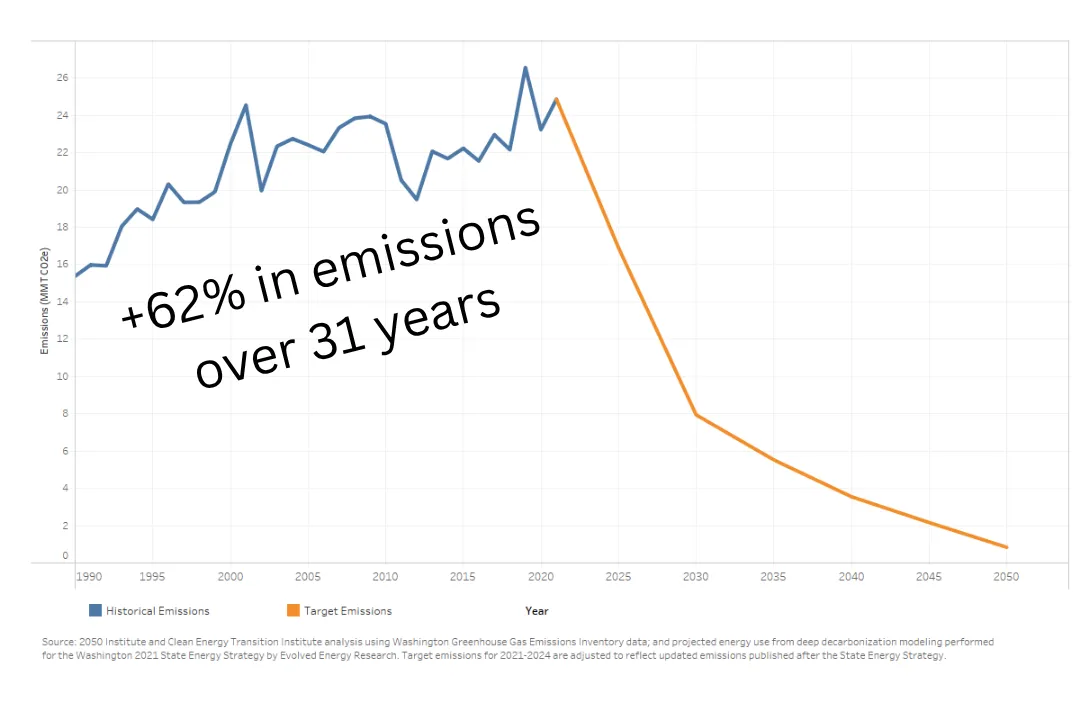
Start with why buildings matter so much here. According to the SCALE 2030 Ecosystem Assessment, emissions from Washington's residential and commercial buildings rose 62% between 1990 and 2021, even as other sectors worked to bend their curves down. Buildings are now 26% of the state's total greenhouse gas emissions, roughly a quarter of the whole problem.
They are also where our energy goes. Buildings are the single largest end use of both electricity and natural gas in Washington, consuming 77% of the state's electricity and 42% of its natural gas. And the dollars are substantial: in 2022, the building sector spent nearly $2 billion on natural gas and about $7 billion on electricity.
Here is a detail I find quietly persuasive. Most of the natural gas we burn is imported from Canada, while Washington is a net exporter of electricity. So shifting buildings from gas toward efficient electricity doesn't only cut carbon; it keeps more energy dollars inside the state. On its own, moving buildings off natural gas would cut Washington's gas emissions by nearly half.
The scale problem
The reason this needs a roadmap and not just more rebates is sheer size. As of 2023, Washington had about 3.3 million housing units, and 92% of them are single-family homes and low-rise multifamily. On the commercial side, a handful of building types, retail and services, mixed commercial use, and warehouses, make up 52% of the floor area, and adding offices and schools brings it to about 75%. Meanwhile one in three homes in the state is a rental, which carries its own stubborn barriers to getting upgrades done.
The roadmap is blunt about what that means. With more than three million homes and hundreds of thousands of commercial buildings, the building stock is simply too large to chip away at year after year with small budgets for incentives and voluntary programs. Business as usual will not get us there. That is why the roadmap puts the state in the lead: the scale, consistency, and coordination the transition requires are beyond what most cities and counties can carry alone.
A whole-system approach
What I appreciate most about the roadmap is that it refuses to hunt for a single silver bullet. Its authors call it a whole-system, 360-degree approach, and the six levers are designed to reinforce one another rather than stand alone. Pull only one and little moves; pull all six and they compound.
Underneath them sits one reframe worth sitting with: treat building performance as a resource. A well-run, efficient building is not just a cost to manage. It is an asset for the grid and for the state's economy, the same way we treat power generation. The roadmap says so directly, aiming to decarbonize buildings while positioning them as strategic assets for the grid and for Washington's economic vitality.
The whole framework maps onto Washington's Clean Buildings Performance Standard, which sorts buildings into tiers, plus a proposed new one:
- Tier 1: commercial buildings over 50,000 square feet, in compliance since June 2026, roughly 8,000 of the state's largest buildings.
- Tier 2: commercial buildings between 20,000 and 50,000 square feet, plus multifamily buildings over 20,000 square feet, due in July 2027.
- Proposed Tier 3: the commercial, multifamily, and single-family buildings under 20,000 square feet that no standard reaches today, which is where most of that 92% of homes lives.
This tiered structure is the world we work in every day at Pilotlight, since helping Tier 1 and Tier 2 buildings meet the standard is our core work, so I read the roadmap with a practitioner's eye. More on that below.
The six levers, and the sixteen actions inside them
This is the heart of the roadmap. Here is each lever in plain language, with its actions.
Building sector goals. Clear, public goals and tracking are the North Star that keeps every other lever pointed the same way. The single action here is to set and track building sector goals, with the Department of Ecology and Department of Commerce developing milestones and a public dashboard. It sounds like bookkeeping, but a target with a date and a scoreboard changes how owners, utilities, and capital all plan.
Building upgrade and performance standards. This lever gives every building a regulated path, and it holds four of the sixteen actions: align the Clean Buildings Standard's energy-use targets with the state's 2050 goals and fill in the interim milestones, eventually expanding to emissions and demand-flexibility metrics; label and upgrade homes and small buildings, starting with a Home Energy Score at time of sale and building toward a Tier 3; phase in a zero-emission heating standard so that when equipment is replaced, what goes in next is clean, which also cuts the nitrogen oxides and fine-particle pollution that harm indoor and outdoor air; and adopt next-generation energy codes, stepping up in 2027 and, by the 2030 code, cutting new-building energy use by a statutory 70 percent with Net-Zero Energy Ready requirements for new homes.
Modern utility regulation. Today we mostly pay utilities for selling more energy, then ask them to help us use less. This lever realigns that with three actions: modernize the utility planning requirements in I-937 (a 2007 law still built around a 15 percent renewable target) to advance distributed energy and grid flexibility; complete and adopt performance-based regulation, tying utility earnings to outcomes like emissions reductions, load flexibility, and virtual-power-plant performance rather than raw sales; and remove the barriers to distributed energy, the hosting-capacity maps, interconnection standards, time-of-use rates, and data access that let rooftop solar and batteries actually count as grid resources.
Accelerated market transformation. This is about making the clean, efficient option the easy and affordable default. Its three actions: stand up a Washington Clean Buildings Market Transformation Hub inside the Department of Commerce to coordinate the field and even lead bulk purchasing of key technologies like heat pumps; invest in stronger energy codes and the compliance support builders and inspectors need; and develop a future-ready clean buildings workforce, growing the energy auditors, compliance experts, and installation technicians the transition will require, in partnership with unions, community colleges, and industry.
Accessible financing tools. Upfront cost is the wall most owners hit, so this lever takes it down. Inclusive Utility Investment lets a utility fund an upgrade with repayment tied to the meter rather than the customer, so it can reach people regardless of credit score or ownership, and it is designed to be bill-neutral, with the monthly charge set below the monthly savings. Washington Builds, the state's new green bank, uses public dollars to pull in private capital; comparable green banks in New York and Connecticut have attracted close to $7 of private investment for every $1 of public money, and the roadmap targets $400 million to $1 billion in capitalization, building on the $25 million the legislature allocated in 2026, with legislated leverage targets of 15 to 1 in residential lending and 3 to 1 in commercial. And a one-stop upgrade platform, modeled on Michigan Saves, gives owners and contractors a single place that scans every federal, state, utility, and local incentive, deducts rebates up front, and applies for financing.
Reliable transition funding. None of this scales on stop-and-go money. The roadmap proposes two durable sources: dedicate a permanent share of Climate Commitment Act revenue to clean buildings, codified in statute the way clean transportation funding already is, and create a Clean Buildings Investment Charge, a small five-year surcharge on utility bills that the legislature can renew. It even sizes the charge: about a third of a cent per kilowatt-hour could raise roughly $246 million a year while adding about $2.87 to the average monthly residential bill, and half a cent could raise about $400 million a year for roughly $4.78 a month, with customers on bill-assistance programs excluded. The point is as much the signal as the dollars, reliable funding tells the whole market it is safe to hire, train, and invest.
One thread runs through all sixteen actions, and it is the E in SCALE: equity. Each action carries a specific plan to make sure the benefits reach the people most often left out, from setting targets for heat-pump installations in highly impacted communities, to green-bank capital reserved for affordable and rental housing, to protecting renters and low-income customers from any new costs. In a transition this large, who it works for isn't treated as an afterthought; it's built into the design.
Start where the buildings are
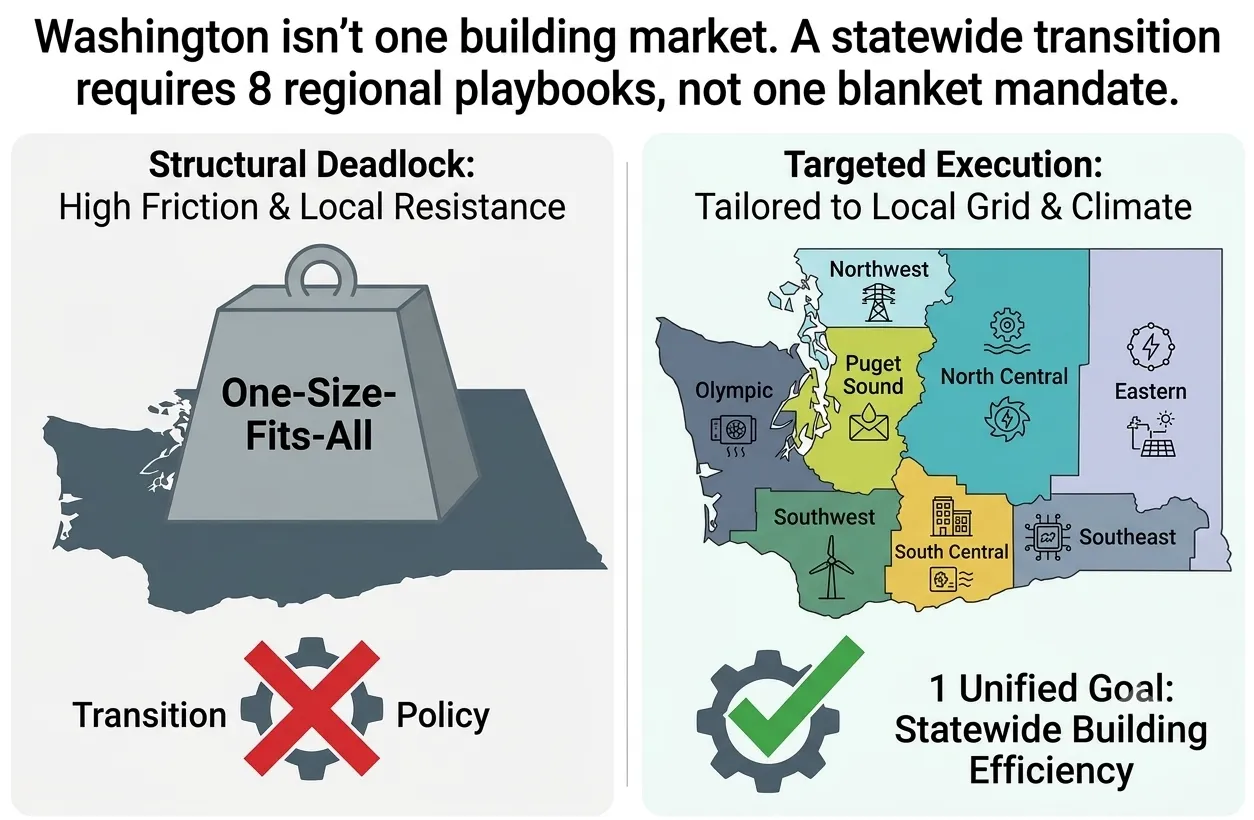
The roadmap also thinks carefully about geography, because a plan built for Seattle won't fit Spokane. The SCALE 2030 team divided the state into eight Clean Energy Regions: Olympic, Northwest, Puget Sound, Southwest, North Central, South Central, Eastern, and Southeast. The concentration points to where to begin. An estimated 66% of the state's commercial floor area sits in the Puget Sound region, with the Eastern region around Spokane a distant second and most other regions under 5%. More than half of all housing units are in Puget Sound, and 79% of housing is in western Washington. The suggestion is pragmatic: pilot approaches where the buildings are, prove what works, then tailor it region by region.
Why I find it credible
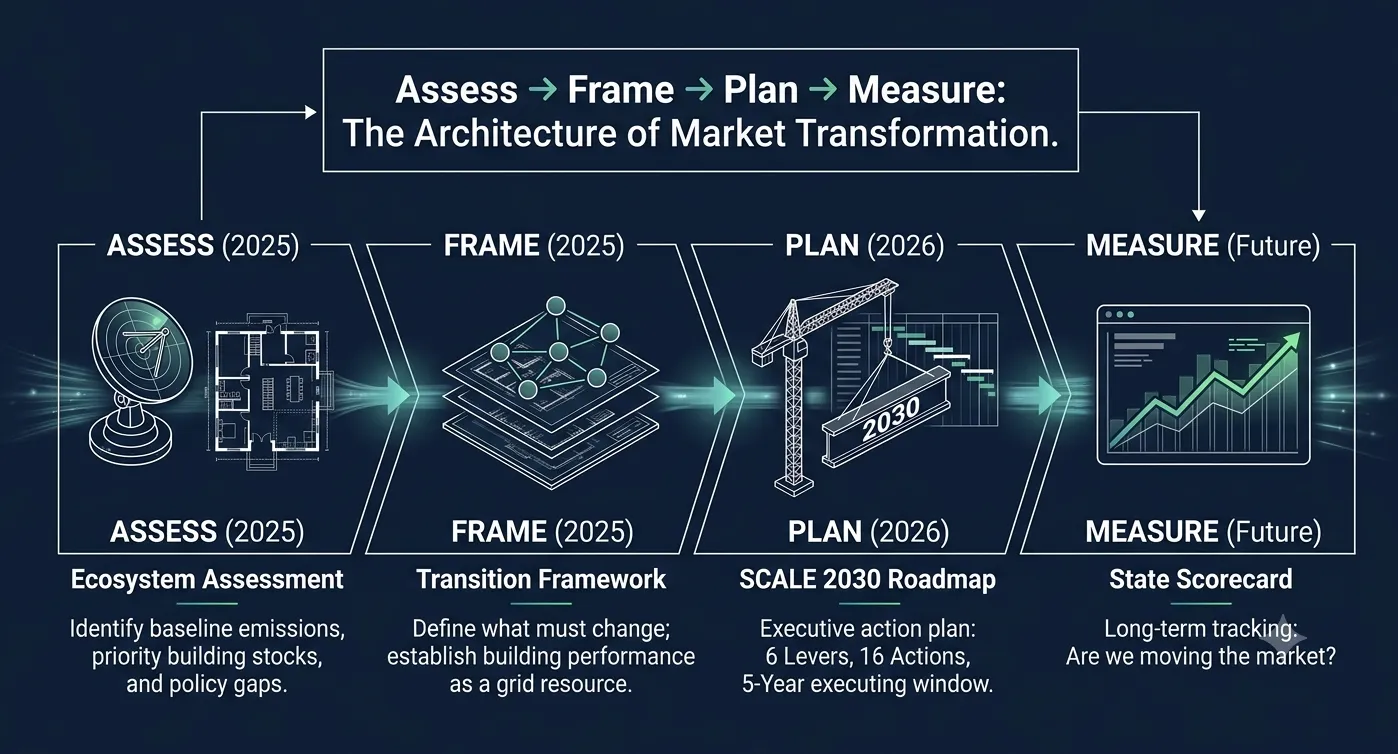
A lot of climate plans are aspiration dressed up as strategy. What makes this one different, to me, is the discipline behind it. It is the third step in a deliberate sequence. First came the Ecosystem Assessment in 2025, which mapped what is actually true about our buildings, the emissions, the building types, the geography, and the policy gaps. Then the Transition Framework, also in 2025, which proposed five strategies for change, anchored by treating performance as a resource. Then this Roadmap in 2026, which turns those strategies into concrete actions. A Scorecard to track the state's progress is meant to follow.
It was also built with people who do this work. The Roadmap's advisory group includes practitioners from Ecotope, McKinstry, Shift Zero, Building Potential, the Washington Department of Commerce, King County, the Seattle Office of Sustainability and Environment, Washington Builds, and more. And it stands on foundations Washington already has: the Clean Energy Transformation Act, the Climate Commitment Act, the 2021 State Energy Strategy, and market-transformation organizations like NEEA and the new Washington Builds green bank.
Where Pilotlight fits
I don't write about this roadmap as a neutral observer. It maps almost exactly onto the work we do at Pilotlight, and that alignment is worth naming.
The roadmap's core bet is that every building needs a clear, regulated path to zero, and that the transition succeeds or fails on whether owners can actually follow it. That second half is exactly the work I do. At Pilotlight, we're the compliance and decarbonization platform that helps building owners, and the teams that serve them, meet performance standards like Washington's Clean Buildings law, Seattle's building emissions standard, and Oregon's building performance standard. We take the parts that stall people, benchmarking energy use, tracking deadlines and tiers, planning upgrades around equipment life, and pulling incentives and paperwork into one place, and turn them into something a building can realistically manage.
Look back at the six levers and the overlap is hard to miss. The standards lever only works if thousands of buildings can benchmark and comply. The financing and one-stop-platform levers are about making upgrades navigable. The market-transformation lever is about capacity and coordination. Policy sets the destination; platforms and services like ours are a big part of how buildings actually reach it, at the scale the roadmap demands.
That is why we pay close attention to work like SCALE 2030, and why we will keep sharing it. A great plan and a practical way to execute it are two halves of the same job, and we are focused on the second half.
The bottom line
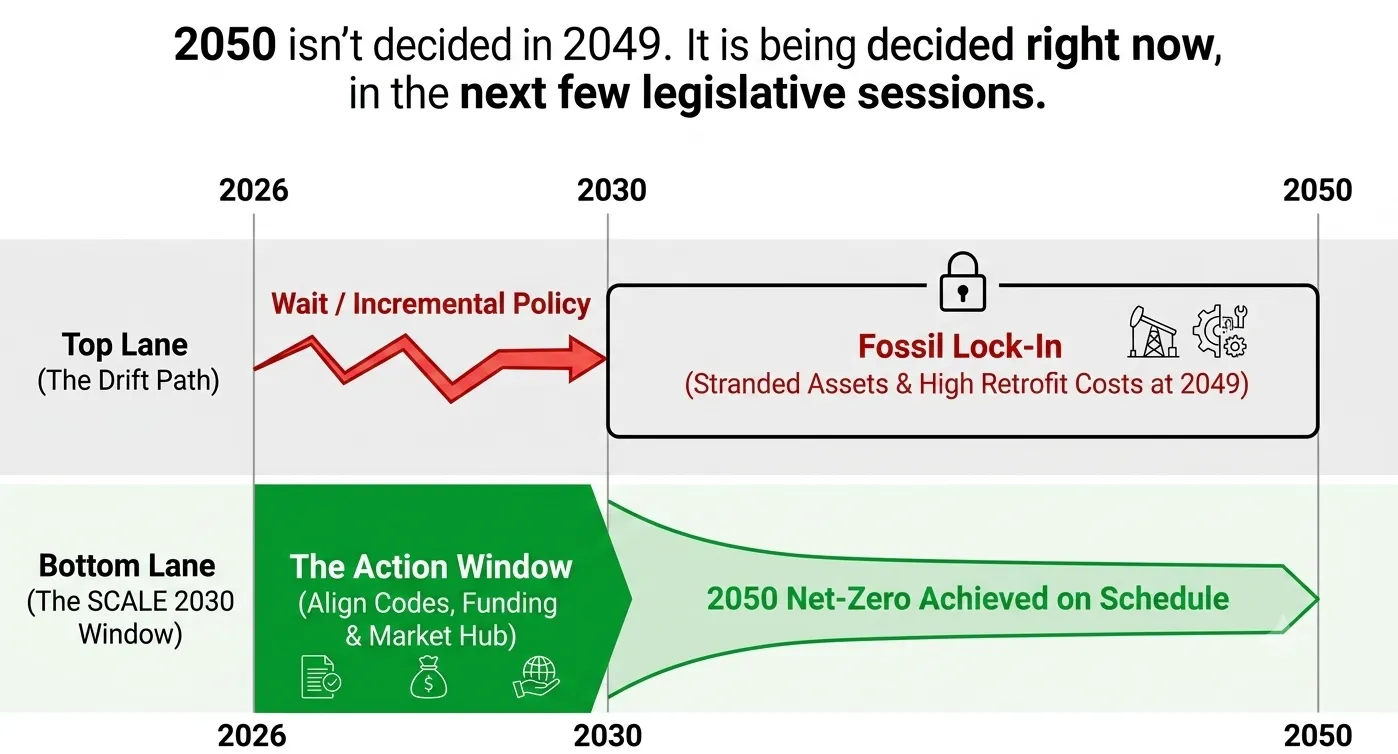
Here is what the whole thing adds up to. Washington has the goals, the building-stock data, the policy foundations, and now a specific, sequenced plan. What it needs is the will to act in the next five years, because the decisions we make now, the codes we set, the standards we align, the funding we secure, largely determine whether 2050 is reachable at all.
The roadmap's authors put it plainly: how we navigate this transition for our buildings will shape the wellbeing and prosperity of future generations. I find that both sobering and motivating. We are not starting from zero, and we are not guessing anymore. The plan exists, it is a genuinely good one, and the task now is to build it.
If any part of this is your world, from policy to the job site to the buildings themselves, I would love to compare notes. A blueprint this good deserves to be more than a PDF.
Sources
- SCALE 2030 Clean Buildings Roadmap for Washington (CETI + 2050 Institute, 2026)
- SCALE 2030 Roadmap Timeline (the sixteen actions, 2026-2030+)
- SCALE 2030 Clean Buildings Ecosystem Assessment (2025)
- SCALE 2030 Clean Buildings Transition Framework (2025)
- About SCALE 2030 (initiatives sequence and SCALE principles)
- Washington Dept. of Commerce, Clean Buildings Performance Standard
- SCALE 2030, Catalyze Clean Buildings Through Washington Builds
- SCALE 2030, Create a Clean Buildings Investment Charge