"I Don't Want to Figure This Out Myself": How to Find a Reputable Service Provider
Tier 2 compliance requires a credentialed qualified energy manager, which means the law assumes most owners will hire someone. Here are the six questions to ask before you do, and the four red flags worth walking away from.
By Jeff Nichols
That sentence, more or less word for word, is the most common thing we hear from Tier 2 building owners.
And my answer is always the same: good, you shouldn't.
Somewhere along the way the message to smaller building owners became *become an expert*. Learn ENERGY STAR Portfolio Manager. Claim your buildings in a state portal. Understand weather normalization. Fill out the spreadsheets.
People don't want to do that, and I don't think they should have to. If you own a 30,000 square foot church or a childcare center or a mid-sized office building, your job is running that organization not learning a federal benchmarking tool.
The law agrees with me, incidentally.
The state built this expecting you to hire someone
Tier 2 compliance requires a qualified energy manager. That is not a suggestion in a guidance document, it’s a requirement with defined credentials attached, and Commerce publishes a roles-and-responsibilities document laying out exactly what the role covers.
Washington wrote a law that assumes most owners would bring in a professional. Hiring one is not an admission that you couldn't handle it, it’s the intended path.
So the real question was never "how do I learn this." It's "how do I find someone good, and how do I know they're good before I've paid them?"
Here is how I'd go about it.
Who actually does this work
Three kinds of firms, and they overlap.
- Mechanical contractors. They know your building's systems because they maintain them. Many have added compliance services, and if you already have a trusted mechanical contractor, that is the first phone call. They may not do the paperwork themselves, but they will know who does.
- Energy consultants and engineering firms. Building energy analysis is the core service rather than an add-on. Often the right choice if your building is complicated, or if you suspect you're well above your target and want to understand why.
- Individual credentialed professionals. Professional engineers, Certified Energy Managers, Energy Management Professionals, qualified energy auditors. Sometimes independent, sometimes inside the firms above. This is the credential that actually signs off on your compliance. For a straightforward Tier 2 building, any of the three can get you there.
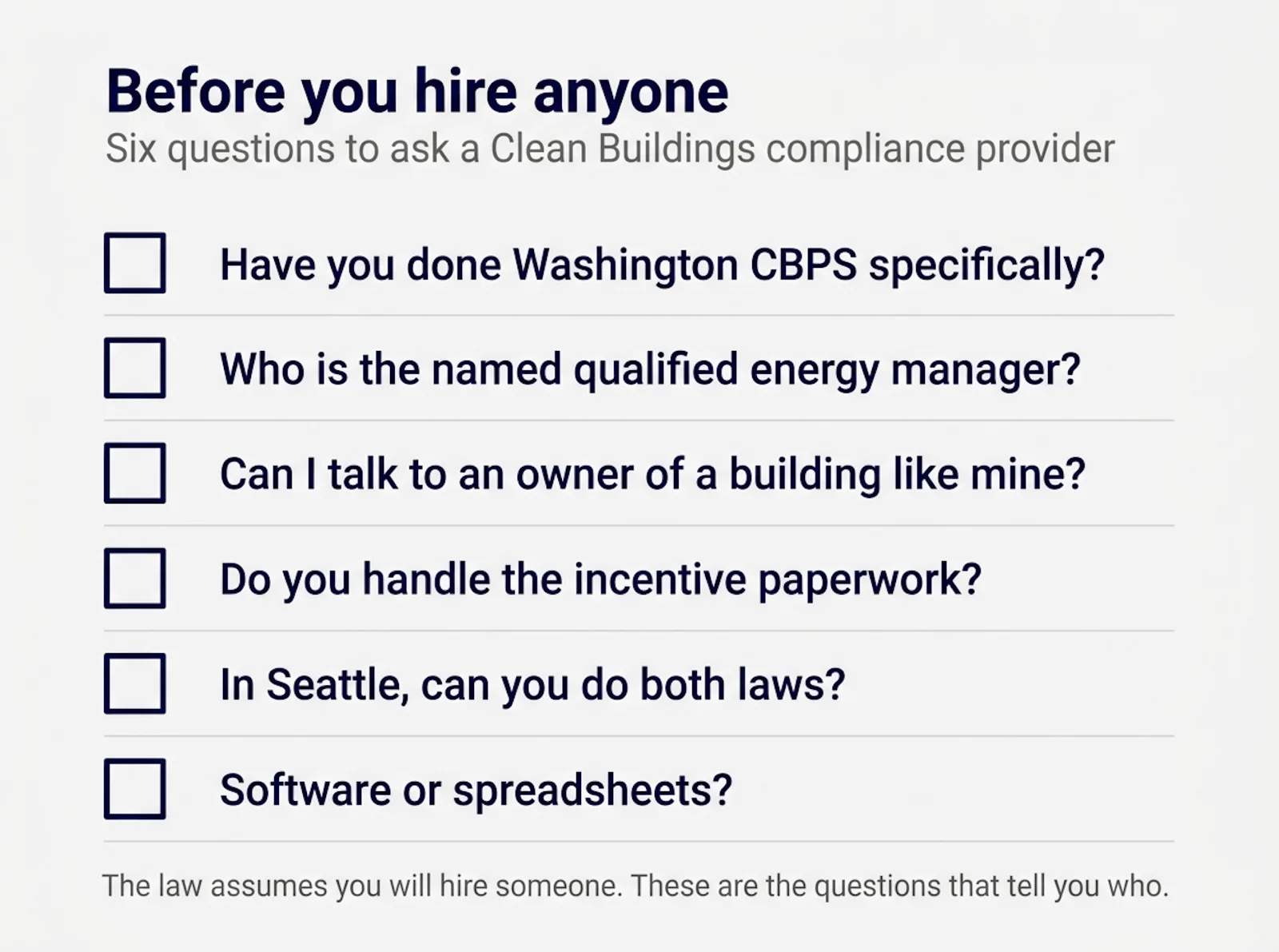
Six questions to ask before you sign anything
- 1. Have you done Washington CBPS compliance specifically? Not benchmarking generally and not energy audits. This program, this state, this portal. Washington was the first state with a building performance standard, which means national firms may be learning it on your building. Ask how many Washington Tier 2 buildings they've taken through to certified compliance.
- 2. Who is the named qualified energy manager on my project? A name, not a firm. "We have credentialed people" is not an answer. The individual signing off is the individual you're actually hiring, and you want to know they exist before the deadline, not during it.
- 3. Can I talk to an owner of a building like mine? Like mine means similar size, similar use, similar sophistication. A firm whose references are all 400,000 square foot office towers may be excellent and still be wrong for a 28,000 square foot worship facility with no facilities staff.
- 4. Do you handle the Early Adopter Incentive paperwork? The incentive is worth up to thirty cents a square foot, seventy-five for qualifying multifamily. It requires its own application through the Clean Buildings Portal, submitted alongside compliance. A provider who does the compliance work and leaves the incentive application to you has left real money on your desk. Ask directly whether it's included.
- 5. If I'm in Seattle, can you do both laws? Seattle's BEPS qualified person credentials match what the state requires, and Seattle's own policy guide says owners may use the same person or vendor for both. One caveat worth knowing: for BEPS benchmarking verification, the qualified person cannot be whoever prepared your annual benchmarking report. A good provider will already know this and tell you before you ask.
- 6. Do you run this on software or on spreadsheets? This sounds like a technical question and it isn't, it's a pricing question. A firm managing compliance in spreadsheets and email threads has a fixed administrative cost per building, and that cost gets recovered from you. At Tier 2 scale, on a building where the entire engagement may be worth a few thousand dollars, that's the difference between a provider who can serve you affordably and one who can't. You are allowed to ask how they work.
Four red flags
- Anyone who guarantees you an exemption. Exemption criteria are defined in statute and the standard, applications go to Commerce, and Commerce decides. Nobody can promise you an outcome they don't control.
- A firm price before anyone has looked at your utility data. The work depends on what shape your data is in, how many meters serve the building, and how far from target you are. A quote issued before any of that is known is a quote that will change, or a quote padded to cover the unknown.
- No named qualified person. See question two. If they can't name the individual, ask when they will be able to, and be uncomfortable with the answer.
- Unsolicited contact telling you you're non-compliant and asking for payment. This one is worth being specific about. Seattle's Office of Sustainability and Environment has posted a warning that communications from soliciting third-party providers are circulating with inaccurate information about compliance status and deadlines. OSE notes that official city emails come from a seattle.gov address, and that official notices, warning letters, and notices of violation will carry City of Seattle branding and will never request payment for services to complete the process. If someone contacts you out of the blue claiming your building is in violation and offering to fix it for a fee, verify with the agency directly before you respond to them.
Where we fit in this
I should be straight about our interest here, because this is a post about hiring people and we are in this market.
Pilotlight doesn't replace the building experts. We help those experts do their work at scale.
We build the software infrastructure that mechanical contractors, energy consultants and building performance professionals use to organize information, manage workflows and complete compliance efficiently. We are not the qualified energy manager. We are what the qualified energy manager runs on.
The reason that matters to an owner is question six above. The administrative overhead of compliance is the thing that makes serving 18,000 smaller buildings uneconomic, and it is the thing that gets priced into your quote.
And if you're a contractor or consultant reading this: roughly 18,000 buildings are converging on July 1, 2027. That is the largest opportunity this market has seen, and the firms that can serve it profitably at volume are the ones that will capture it.
One last thing
You do not have to have this figured out before you make the call. You don't need to know your square footage, your target, or which tier you're in. A competent provider will establish all of that in the first conversation.
That said, walking in knowing what you're dealing with makes every conversation on this list shorter. We built a compliance navigator that will tell you whether your building is covered and which tier it's in. It takes a few minutes, it's free, and it asks nothing of you.
Then make the call. That's the only part that actually matters.
Next week, for anyone who has a question rather than a project: the free help that already exists, and where to call.
If you'd like help finding someone, reach out and I'll point you in the right direction.
Sources
- Washington Dept. of Commerce, CBPS Tier 2 compliance (qualified energy manager requirement, roles and responsibilities, portal applications)
- Washington Dept. of Commerce, CBPS Support and Resources (qualified person, qualified energy auditor and qualified energy manager roles, directories)
- Washington Dept. of Commerce, Tier 2 Early Adopter Incentive Program (incentive amounts, application process)
- Seattle Office of Sustainability and Environment, Energy Benchmarking (warning on third-party solicitations, official communication standards)
- Seattle OSE, Guide to the Seattle Building Emissions Performance Standard, January 2026 (matching credentials, benchmarking verification independence)