Why 469 Projects Became One: How an Interconnection Queue Actually Works
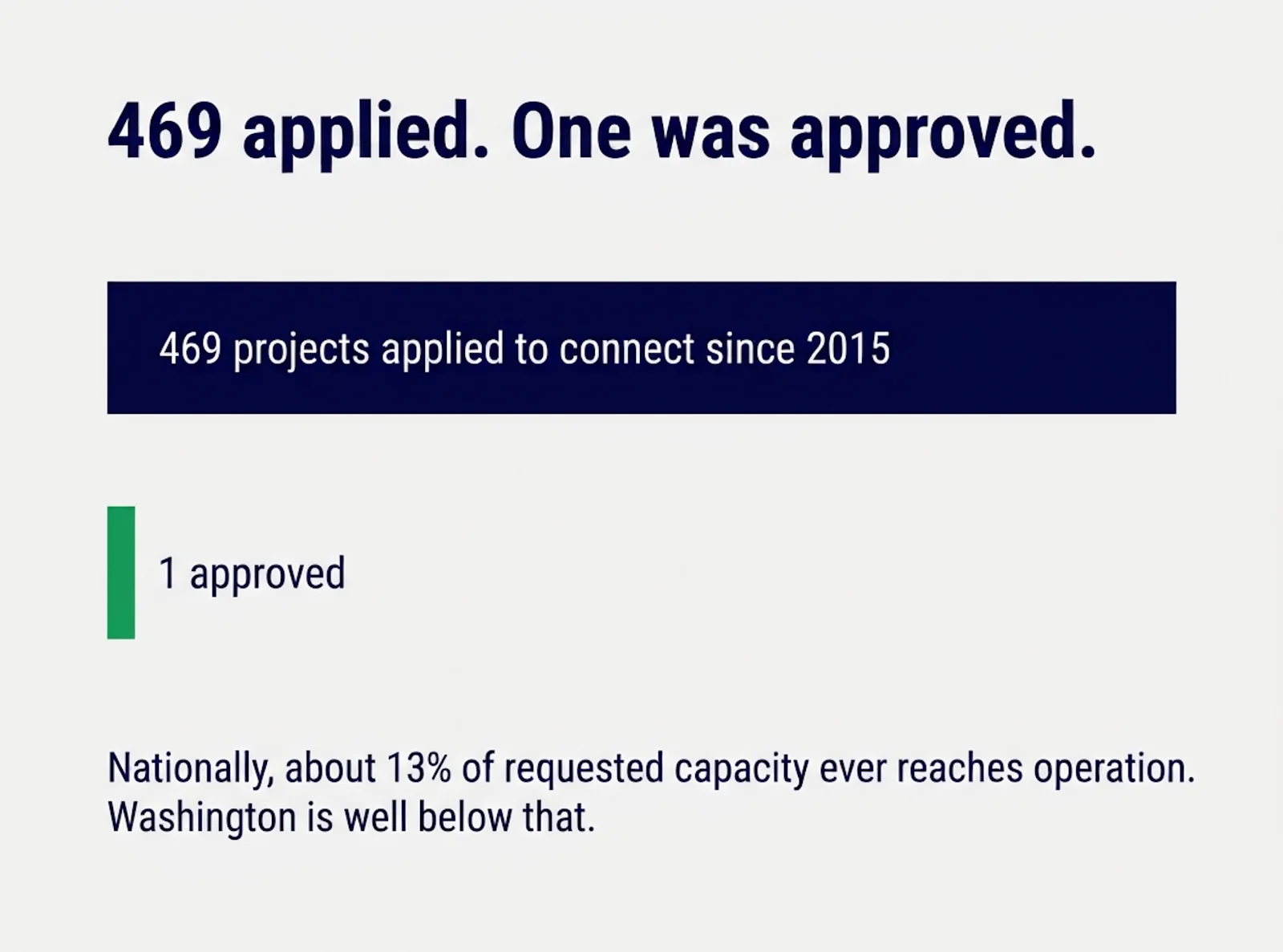
Washington approved one renewable project out of 469 applications since 2015. Nationally, only 13% of requested capacity ever reaches operation, which means half this story is a design problem the whole country shares and half of it is ours. Here is how the mechanism actually works.
By Jeff Nichols
Washington's problem with clean energy is not that nobody wants to build here. It’s that 469 projects applied to connect to the regional grid since 2015 and exactly one made it through.
I’ve written about that number before, and the usual reaction is some version of: what on earth is wrong with the Bonneville Power Administration. It’s a fair reaction, but it’s also the wrong question, or at least an incomplete one, and I have come to think the more useful question is how an interconnection queue works at all. Because once you understand the mechanism, the 0.2% stops looking like negligence and starts looking like what it actually is, which is a process doing exactly what it was designed to do, in conditions nobody designed it for.
The national picture first
Before blaming anyone local, it helps to know that almost everyone is bad at this.
Lawrence Berkeley National Laboratory tracks interconnection queues across the country and publishes the results annually. At the end of 2025 there were roughly 2,061 gigawatts of generation and storage sitting in active queues nationally, spread across about 8,200 projects. Berkeley Lab's dataset covers operators representing about 98% of installed US generating capacity, so that is close to the whole picture rather than a sample.
Now the part that matters. Of the projects that requested interconnection between 2000 and 2020, only about 13% ever reached commercial operation. Roughly 75% were withdrawn. The median project that does get built now takes more than five years from request to operation.
Two things are worth holding separately there. Most of what gets proposed anywhere in the country never gets built, which is a design problem the whole system shares. And then there is the size of the gap between that national picture and ours, which is not a rounding error and is not explained by the national design problem. Washington is much worse than average at something the entire country is bad at.
The queue is not a line
Here is the thing almost nobody outside the industry knows, and it explains most of the rest.
An interconnection queue is not a line at a deli counter. It is not a sequence where your project is studied, approved or denied, and the next one moves up. It is a set of interlocking engineering studies, and the cost assigned to your project depends on which other projects ahead of you in the queue end up getting built.
That sounds like a technicality, but it’s the whole problem.
When a developer applies, the grid operator studies what upgrades are needed to connect that project, assuming everything ahead of it in the queue also gets built. If three projects ahead of yours withdraw, the upgrades they were going to pay for do not happen, and suddenly your project is responsible for a much larger share of the bill. Your cost estimate changes through no decision of your own.
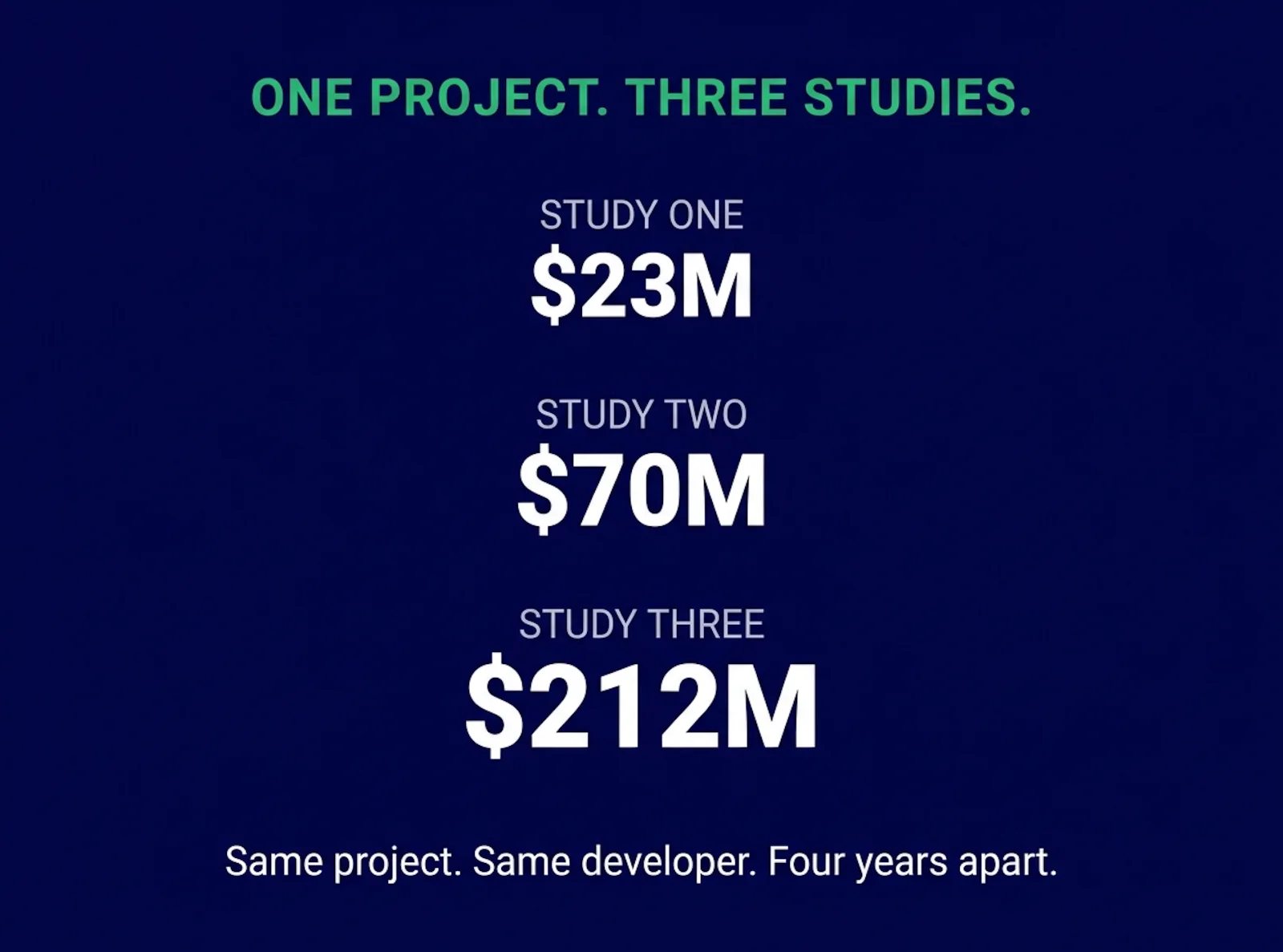
David Brown of Obsidian Renewables has a 400 megawatt solar project in Oregon that has been through three of these studies. As OPB and ProPublica reported, the first put his cost at $23 million to build a substation that Bonneville would then own. The second said $70 million. The third said $212 million. He applied in 2020 and does not expect an answer before 2028.
To be fair about the cause, Bonneville attributed that escalation in part to supply chain and labor costs rather than to the queue alone. Both things can be true. A near-tripling over four years tells you something about construction inflation, and it also tells you that a developer carrying this kind of estimate has no stable number to finance against.
And when he walks away, as most do, his withdrawal reshuffles the costs for everyone behind him. The study has to be redone and the process restarts, which is why a single large departure can slow a whole cluster of unrelated projects.
Getting through the studies is not the end of it either. Berkeley Lab counts 549 gigawatts nationally that already hold a draft or executed interconnection agreement and still have not reached commercial operation. Those projects cleared the process and are still not delivering power.
A queue where speculative applications are cheap to file and withdrawals impose costs on everyone else is a queue that will clog. That is not a Northwest invention, it’s how most of the country has run interconnection for twenty years.
There is a detail in the 2025 national data worth pausing on. The queue got shorter last year, down about 10%. The reason was not that projects got built, but that developers gave up. Berkeley Lab is explicit that it is too early to read the decline as evidence that reform is working.
The composition shifted too. Natural gas capacity in the queue rose 86% in a single year to 253 gigawatts, while solar fell 19%, storage 16% and wind 19%. What is waiting to connect is becoming less clean, not more.
What is specific to here
The national design problem explains why most projects everywhere fail, but it doesn’t explain one approval out of 469. Three things are local.
The first is ownership. The West holds the largest active interconnection queue in the country, 567 gigawatts of it, more than ERCOT. And Bonneville owns roughly 75% of the Northwest's transmission system, so within this region there is no alternative route. A developer told OPB and ProPublica that he did not know a single place in Oregon or Washington where he could connect a new solar project and get transmission. Not one. In most of the country, a project that cannot get through one operator's queue has somewhere else to go.
The second is that the lines are full. More than 200,000 megawatts of proposed renewable energy is waiting on Bonneville's signoff, enough to power the Northwest nearly ten times over. One proposed wind farm has been in the queue more than sixteen years.
The third is who pays for upgrades. Bonneville has largely required the individual developer requesting a connection to fund the grid upgrade that connection needs, and to put money down up front, even though the stronger grid serves many customers for decades afterward. That is the mechanism behind the $23 million becoming $212 million. It is also the mechanism that makes every withdrawal more likely than it otherwise would be.
Bonneville's side of this deserves airing. Its vice president of transmission marketing and sales has pointed out that the up-front deposits exist to keep existing ratepayers from covering the bill when a developer walks away, and that other regions have more control over who pays these costs because their networks sit under a single operator. Neither of those is an unreasonable position.
Worth saying plainly: Bonneville's caution has a rationale. Its vice president for transmission planning put it directly in 2024, that the agency cannot speculate and build a transmission line to nowhere. An agency that is required by law to recover every dollar from its ratepayers, and that is still carrying debt from a nuclear program that collapsed in the 1980s, is not going to gamble. That is a reasonable institutional instinct. It is also producing a 0.2% approval rate, and both of those things are true at once.
The one project that made it
It is worth knowing what the single approval actually was, because it is instructive.
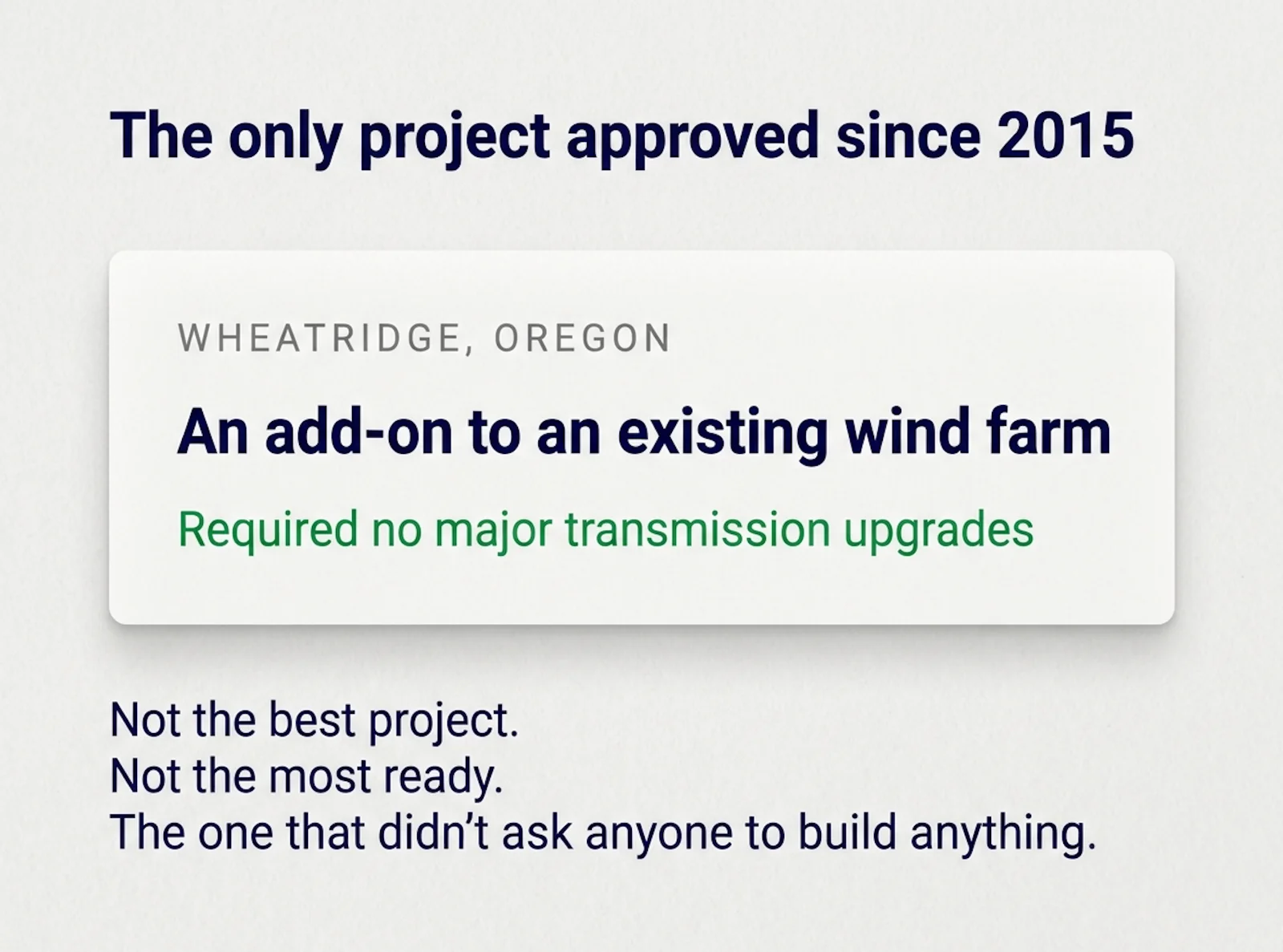
It was an add-on to an existing Portland General Electric wind farm at Wheatridge and didn’t require any major transmission upgrades.
That’s the tell, The projects that get through are the ones that do not need anything built. Which means the queue is not really selecting for the best projects, or the most ready, or the most needed. It is selecting for the projects that happen to sit next to existing capacity.
What is actually changing
Enough has moved in the last year that the picture is no longer static.
Bonneville has shifted its study approach, moving from reviewing proposals one at a time in the order received toward prioritizing projects that are closest to ready. That is the same direction FERC pushed the whole country with Order 2023, and it addresses the speculative-application problem directly.
The agency has also committed to roughly $5 billion in transmission upgrades over a decade, and separately proposed about $3 billion in new construction including 500-kilovolt lines across Oregon and Washington. Renewable energy advocates have characterized some of that as overdue maintenance rather than expansion, which is a fair criticism and does not make it worthless.
On the state side, Washington's Department of Commerce has offered its own staff to help Bonneville work through the backlog, though as of the most recent reporting it was not clear whether the agency would accept. Washington also created an Electric Transmission Authority in 2026 with an explicit mandate to plan and finance the lines the region needs. And there is active legislative interest in letting transmission run through highway rights-of-way, which the state transportation department has said it cannot allow without the legislature acting first.
None of that is fast. All of it is movement, and a year ago most of it did not exist.
Why this matters if you own a building
You might reasonably wonder what any of this has to do with a 40,000 square foot building in Tacoma.
Two things.
The first is your bill. When the region cannot add its own supply and demand keeps climbing, utilities buy on the open market during the expensive hours, and those costs land on customers. Rate increases have many causes and it would be wrong to pin them all on interconnection. But part of what you are paying for is power that was proposed, studied, repriced, and abandoned.
The second is timing. Every megawatt stuck in that queue is a megawatt that takes five years or more to arrive, if it arrives. Efficiency and load flexibility in existing buildings do not go through an interconnection queue at all. They need no new transmission, no study cycle, and no cost-allocation fight. The region's own draft power plan counts more than a thousand average megawatts of energy efficiency as a core resource precisely because of that.
That is not an argument that buildings substitute for transmission, they don’t. It’s an argument about sequence. The wires will take a decade, but the buildings are already standing.
Sources
- OPB and ProPublica, How the Pacific Northwest’s dream of green energy fell apart (May 12, 2025)
- OPB, Our reporting showed Washington ranks last in green energy growth. Now the state is working to speed it up (January 26, 2026)
- OPB, Washington state’s clean-energy bottleneck leads to calls for reform (July 24, 2026)
- Lawrence Berkeley National Laboratory, Queued Up: 2026 Edition, Characteristics of Power Plants Seeking Transmission Interconnection as of the End of 2025 (June 2026)
- Lawrence Berkeley National Laboratory, Grid Connection Queues data and annual series
- American Public Power Association, Backlog of power plants seeking transmission grid connection eased somewhat in 2025 (July 1, 2026)
- Utility Dive, BPA plans $3 billion in transmission projects, including 500-kV lines (October 2024)
- Northwest Power and Conservation Council, Draft Ninth Power Plan (August 2026)