My Deadline Already Passed. Now What?
Missing your Clean Buildings deadline doesn't trigger a penalty. What happens next depends almost entirely on what you do in the 30 days after the notice arrives, and the standard is more forgiving than most owners expect.
By Jeff Nichols
Let me answer the question directly, because if this is your situation you have probably been avoiding finding out.
You are not in as much trouble as you think. But that stops being true the longer you do nothing, and doing nothing is the only path that reliably ends in a fine.
Here is how it actually works.
Missing a deadline does not trigger a penalty
This is the part almost nobody knows, and it changes the entire emotional weight of the situation.
There is no automatic fine on July 2 for a Tier 2 building that did not file on July 1. Commerce works through legal notice, and the clock that matters starts when that notice arrives, not when the deadline passed.
For a Tier 2 building that notice is a NOVCI: a Notice of Violation, Opportunity to Correct, and Intent to Assess Penalties. It is a single combined notice, and the standard requires Commerce to give you at least 30 calendar days to cure the violation.
Which means the question is not "did I miss the deadline," It's "what do I do in those 30 days."
For Tier 2 buildings, the answer is remarkably forgiving
The maximum administrative penalty for a Tier 2 building that fails to submit compliance documentation is $0.30 per square foot of gross floor area. That is a flat figure assessed per compliance period, not a daily or annual accrual, which is a meaningful difference from how Tier 1 works.
One caveat worth knowing. Once a penalty is past due, interest accrues on it under state law, and unpaid penalties can be referred to a collection agency. The headline number does not grow while you are deciding what to do, but it grows after you have been ordered to pay and haven't.
For a 30,000 square foot building, that is $9,000. For a 50,000 square foot building, $15,000.
Nobody wants that bill. But now the part that matters:
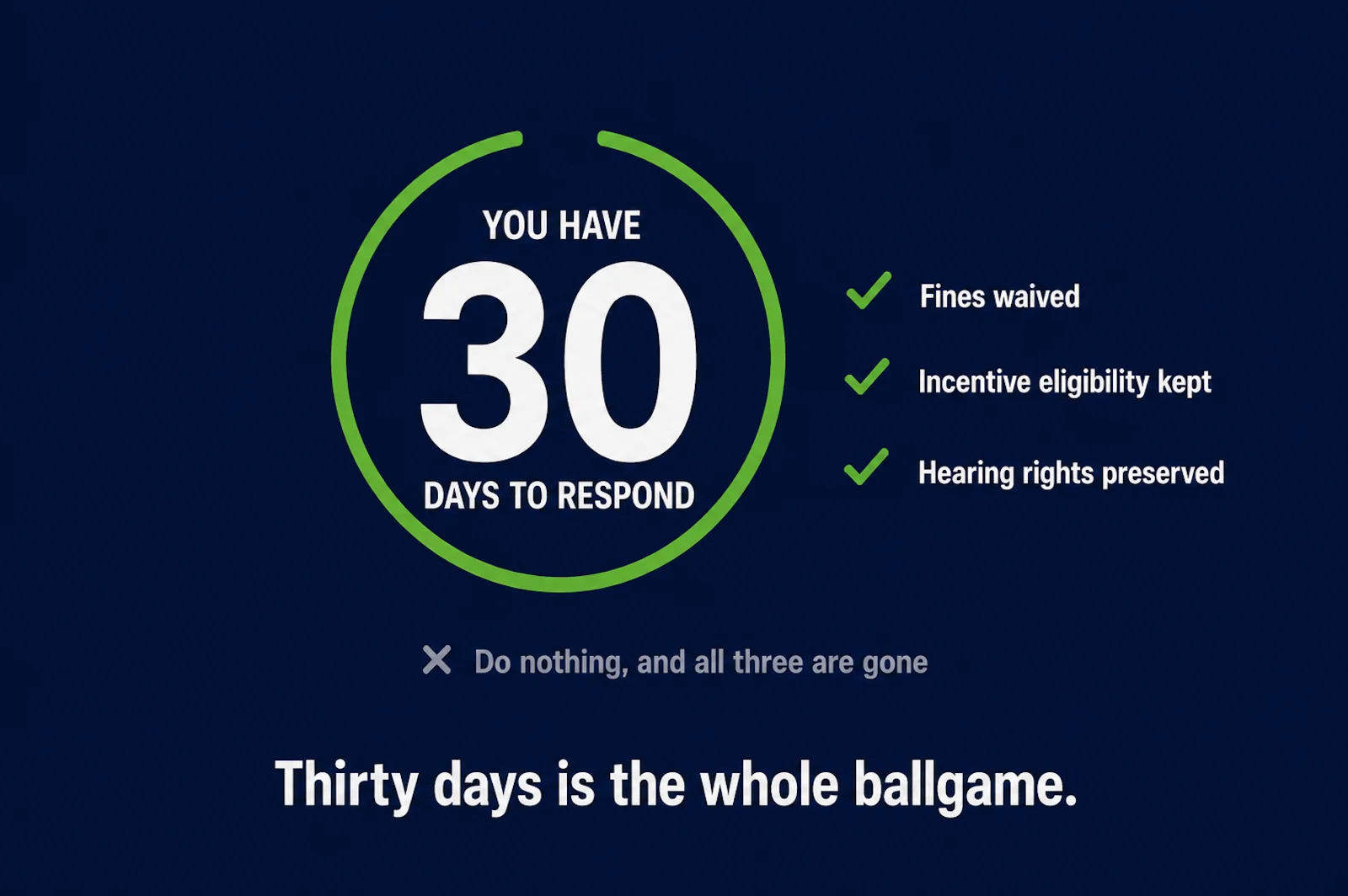
For a Tier 2 owner who responds within 30 days of the NOVCI with documentation demonstrating compliance, or who successfully challenges the notice: fines shall be waived, and the owner may be eligible to apply for the Early Adopter Incentive Program.
Read that again.
You can miss the deadline entirely, receive a notice of violation, respond inside 30 days, comply, pay nothing, and still be eligible for the incentive.
That is not a loophole anyone found, it’s the program working the way it was designed. Commerce built the penalty as a device for getting your attention, not as a revenue line.
The door swings both ways, though. An owner who responds by choosing to pay the fine rather than pursuing compliance is assessed the full thirty cents per square foot and may not be eligible for the incentive. Same thirty days, opposite outcome. Paying is the expensive option twice over.
And an owner who does not respond at all inside thirty days waives their right to a hearing, and Commerce may issue a final order assessing the penalty. Silence is the only response with no upside at all.
The symmetry worth noticing
The maximum Tier 2 penalty is $0.30 per square foot.
The base Tier 2 Early Adopter Incentive is also $0.30 per square foot.
On a 40,000 square foot building, the gap between acting and not acting is $12,000 coming in versus $12,000 going out. A $24,000 swing on an identical building doing identical work, decided entirely by when.
We will come back to that next week, because it deserves a post of its own.
For Tier 1 buildings, engagement is worth six figures
Tier 1 works differently, and the sequence matters. Tier 1 owners get two notices rather than one. The first, a NOVC, gives at least seven calendar days to cure. Only if that passes does Commerce issue a NOVI, and that is what opens the thirty-day window that decides what you actually pay.
Tier 1 penalties are considerably steeper, and the difference between responding and not responding is enormous.
The base penalty is up to $5,000 per building, plus an amount that accrues at up to $1.00 per square foot per year, capped at 18 months. Eighteen months at that rate works out to $1.50 per square foot, which is the maximum figure Commerce publishes. On a 100,000 square foot building, the ceiling is roughly $155,000.
Now compare the paths.
An owner who submits a mitigation plan within 30 days of the notice and then actually achieves compliance sees the base drop to $1,500 and the accrual rate drop from $1.00 to $0.20 per square foot per year. On that same 100,000 square foot building, run 500 days past the deadline, that works out to roughly $29,000.
Roughly $29,000 versus up to $155,000. Same building, same lateness. The only variable is whether the owner picked up the phone.
Nobody wants either bill, but one of them is survivable and the other one isn't, and the difference is a form filed inside a 30-day window.
An owner who submits a plan and then fails to follow through is back at the full amount. The mitigation path is not a delaying tactic and it is not meant to be one. It’s a genuine offer to owners who intend to comply.
Your five options when a notice arrives
The standard lists them explicitly, and it is worth knowing there are five rather than two.
- Comply. Submit the compliance report. Fines waived, incentive eligibility preserved.
- Apply for an extension. Extensions came in with the 2026 rulemaking and give you a two-year delay on your compliance date. The application window runs from six months before your compliance date to six months after it, which makes this the one door explicitly open to owners who have already missed.
- Apply for an exemption, if your building qualifies.
- Submit your intent to pay the penalty. Costs you the full thirty cents and likely your incentive eligibility.
- Request an administrative hearing to challenge or mitigate. Also thirty days, also in writing, and Commerce attaches the form to the notice.
Four of those five leave you better off than the fifth. All five leave you better off than doing nothing.
What to actually do, in order
If your deadline has passed, or you think it might have, five things.
- 1. Confirm whether you are actually covered. Log into Commerce's Clean Buildings Portal and check the Tier 2 Data Pool, where you can search buildings by owner or address. Some owners discover they were never covered. Others discover they own three covered buildings instead of one.
- 2. Respond to any notice you have received, immediately. Two separate rights run on a 30-day clock from the date of that notice. You have at least 30 calendar days to cure the violation by submitting your compliance documentation. You also have 30 days to file a written request for an administrative hearing if you want to challenge it. Both are rights. Neither survives being ignored, and most owners never learn the second one exists. If you are unsure whether a notice was sent, contact Commerce and ask. Notices go to the property taxpayer of record, which is frequently not the person managing the building, so "I never got one" is common and not a defense.
- 3. Start benchmarking now, before you have a plan. Request your energy data from your utility, which they are legally required to provide. Get it into ENERGY STAR Portfolio Manager. This is the longest-lead item and it can begin today without anyone's permission.
- 4. Engage a qualified professional. Tier 2 compliance requires a qualified energy manager. Commerce maintains directories, and free help exists, which is the subject of a post later in this series.
- 5. Document everything you do, with dates. Good-faith progress is not a vague concept here. It is what a mitigation plan is made of, and it is what turns a $155,000 exposure into roughly $29,000.
Two more doors, if you need them
Conditional compliance is a Tier 1 mechanism. It exists for owners on the Meeting the EUIt or Investment Criteria pathways who need more time to benchmark after installing efficiency measures. If you are Tier 2 this is not your door, and Commerce's own guidance notes that owners weighing it may be better served by an extension anyway.
Exemptions exist too, but the Tier 2 window closes January 2, 2027, which is 180 days ahead of the compliance date. If there is any chance your building qualifies, that conversation cannot wait.
Extensions are the door that matters, and they apply to Tier 1 and Tier 2 alike. Added in the 2026 HB 1543 rulemaking, an approved extension delays your compliance date by two full years. The application window runs from six months before your compliance date to six months after it.
Read that second half again. Six months after. If your deadline went by within the last half year, this is the first call to make.
The thing I want you to take from this
The goal of this program isn't to fine building owners.
Commerce provides technical assistance, training, monthly office hours, multiple compliance pathways, exemptions and extensions precisely because the objective is to get buildings engaged. This summer, having watched owners work through the first real deadline, the state's response was to update the rules and add flexibility. Not to tighten the screws.
There has to be a consequence for simply ignoring the law. But the consequence is designed to be avoidable, and it is avoidable right up until the moment you decide not to answer the mail.
The best time to start was last year.
The second-best time is this week.
Next week we look at the money, and at why the same $0.30 that shows up as a penalty here shows up as a check if you move first.
If your deadline has passed and you are not sure what to do next, reach out. That conversation is a lot shorter and less painful than people expect.
Sources
- Washington State Clean Buildings Performance Standard, July 2026 integrated document, Annex Y5 and Annex Z5
- Washington Dept. of Commerce, CBPS 047 Guidance: Tier 1 and Tier 2 Compliance Options, published 07/29/2026 (compliance pathways, extensions, conditional compliance scope, administrative hearings)
- Washington Dept. of Commerce, CBPS Tier 1 compliance (Tier 1 penalties, Section Z5 assessment and appeals)
- Washington Dept. of Commerce, Tier 2 Early Adopter Incentive Program (base incentive amount)
- RCW 19.27A.210, State energy performance standard (statutory penalty authority)