CBPS vs. Seattle BEPS: Efficiency vs. Decarbonization
CBPS asks how much energy you use. BEPS asks how much carbon that energy emits. Seattle's emissions factors, the two laws side by side, and how the deadlines stack for your building's size.
By Jeff Nichols
In my last blog I made the case that Washington’s Clean Buildings Performance Standard and Seattle’s Building Emissions Performance Standard are not the same law told twice. Today, the specifics.
The one-line version: CBPS asks how much energy you use, and BEPS asks how much carbon that energy emits. Everything else follows from that.
Why the metric changes everything
CBPS measures energy use intensity, or EUI, in thousands of BTUs per square foot per year, and it is fuel-agnostic. A well-run building with an efficient gas boiler and a well-run building with an efficient heat pump can post the same EUI and both comply.
BEPS measures greenhouse gas intensity, or GHGI, in kilograms of CO2 equivalent per square foot per year. The calculation takes the energy you used from each source, multiplies it by that source’s emissions factor, and divides by your square footage. Which means the fuel is not a detail in the BEPS calculation. The fuel is most of the answer.
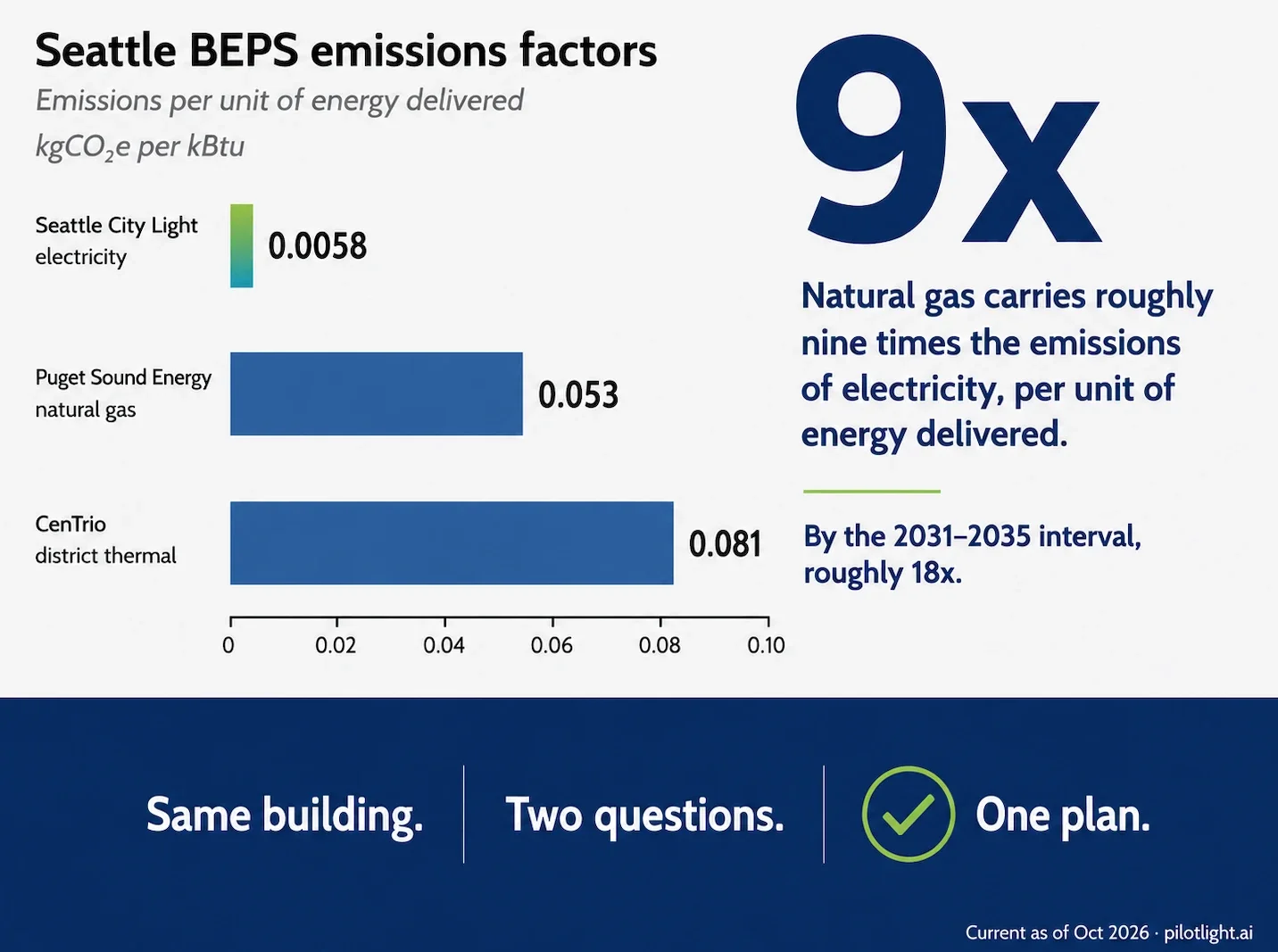
Here are the factors Seattle actually uses, from the 2025 Director’s Rule:
- Seattle City Light electricity: .0058 kgCO2e per kBtu
- Puget Sound Energy natural gas: .053
- CenTrio district thermal energy: .081
Look at the gap. A unit of energy delivered as natural gas carries roughly nine times the emissions of the same unit delivered as electricity in Seattle, and district steam carries about fourteen times. The gap is also widening on purpose: Seattle’s provisional electricity factor for the 2031 through 2035 interval drops to .0029 while the gas and steam factors hold steady, so by the time the first emissions targets come due, gas will carry roughly eighteen times the emissions of electricity and steam roughly twenty-eight times.
That is not an accident in the math. Seattle City Light’s power is largely carbon-free, and the city wrote a law that rewards buildings for using it. In plain English: BEPS is an electrification roadmap with a compliance deadline attached.
What this means practically
Two consequences catch owners out.
First, you have to document your fuel mix, not just your total consumption. A CBPS-oriented benchmarking exercise can get away with knowing how much energy went into the building, but a BEPS calculation needs to know how much came from each source, because each source carries a different factor. If your data collection was built for the state law, check that it captures fuel breakdown before you need it.
Second, ENERGY STAR Portfolio Manager’s built-in emissions factors are not compliant for BEPS. Seattle publishes its own factors and requires those, which means a number that looks right in Portfolio Manager can be wrong for the city.
Side by side
| WA Clean Buildings (CBPS) | Seattle BEPS | |
|---|---|---|
| The question | How much energy do you use? | How much carbon does that energy emit? |
| Metric | EUI, kBtu/SF/yr | GHGI, kgCO2e/SF/yr |
| Fuel type matters? | No, fuel-agnostic | Yes, it’s most of the calculation |
| Administered by | WA Dept. of Commerce | Seattle Office of Sustainability & Environment |
| Who’s covered | Statewide. Tier 1 over 50,000 SF; Tier 2 from 20,000 to 50,000 SF plus multifamily | Seattle only. Nonresidential and multifamily over 20,000 SF, excluding parking. Industrial and manufacturing exempt |
| Roughly how many | ~28,000 buildings | 4,135 buildings |
| First deadline | Tier 1: June 1, 2026 through 2028 by size. Tier 2: July 1, 2027 | Benchmarking verification + GHG report: Oct. 1, 2027 through 2030 by size |
| Performance target due | Tier 1: at the first deadline. Tier 2: standard adopted by Dec. 2030, effective no earlier than 2031 | 2031 through 2035 by size |
| Penalties | Tier 1: up to $5,000 per building plus $1.50/SF per year, capped at 18 months. Tier 2: up to $0.30/SF | Missing a target: up to $10/SF nonresidential, $7.50/SF multifamily, $2.50/SF affordable housing, assessed once per five-year interval. Failing to report: up to $15,000 over 50,000 SF, $7,500 under |
| Credentialed professional | Yes, qualified person | Yes, same credentials. But cannot be whoever prepared your benchmarking report |
The timing question, answered properly
You will hear the advice “plan for both at once.” It is good advice, but which version applies depends entirely on your building’s size, and the differences are large.
If your building is between 90,000 and 220,000 square feet, your CBPS deadline is June 1, 2027 and your BEPS deadline is October 1, 2027, four months apart. Between 50,000 and 90,000, it is June 1, 2028 and October 1, 2028, also four months. For those buildings, running two separate projects is close to malpractice: same data, same building, same credentialed professional, four months apart. If your building is over 220,000 square feet, your CBPS deadline has already passed and BEPS reporting is due October 1, 2027, which is sixteen months rather than four.
And if you are a Tier 2 building in Seattle, which is most of the buildings this series is written for, your two deadlines are years apart. CBPS is July 1, 2027. BEPS benchmarking verification and your GHG report are not due until October 1, 2029 if you are between 30,000 and 50,000 square feet, or October 1, 2030 if you are between 20,000 and 30,000.
That is genuinely good news, and it comes with one piece of advice. Do the 2027 work with the 2029 question in mind. You are going to gather energy data next year either way, and gathering it with fuel sources broken out costs you almost nothing extra now while meaning the carbon question is already answered when it arrives. Doing it twice is what costs money.
One more thing worth knowing
If your building runs entirely on electricity, Seattle’s Director’s Rule exempts it from meeting the greenhouse gas intensity targets and from submitting a greenhouse gas report, for all compliance intervals, though you still owe benchmarking verification and reporting. Given the emissions factors above, that exemption is doing exactly what the law intends. The buildings that already made the switch are done with the hard part.
Where we fit
Two laws, two metrics, two agencies, and deadlines that stack differently depending on building size is precisely the kind of problem that gets expensive when it is handled one building at a time on a spreadsheet. That is the work we do, and it is why we spend so much time on the difference between these two standards.
What to do next
Same building. Two questions. One plan.
Find out which deadlines apply to your building, collect your energy data with fuel sources broken out, and hire one qualified person who can answer both questions. Next week we start Unit 2, and we begin where most owners actually want to begin: which tier am I in, and why does it matter?
If I can help you sort out which set of dates is yours, reach out.
Sources
- Seattle OSE, “BEPS GHGI Targets & GHG Emissions Factors,” January 2026.
- Seattle OSE, “Building Emissions Performance Standard: FAQs.”
- Seattle OSE, Director’s Rule 2025-01, final, December 2025.
- Washington State Department of Commerce, “CBPS Tier 2 Compliance.”
- Washington State Department of Commerce, “CBPS Tier 1 Compliance.”